 English
 Spanish
 Callback
How to Get Your Driver's License in New York: What You Actually Need

Table of Contents
- Quick Overview: Your Path to a NY License
- What It Actually Costs
- Before You Start: Requirements Checklist
- Getting Your Learner Permit
- Required Training & Education
- Practice Driving: Where the Real Learning Happens
- The Road Test: How to Pass First Try
- Special Situations Worth Knowing
- After Passing: Getting Your License Card
- Expert Tips from the Road
- Your License Journey Starts Now
Getting your New York driver's license opens up opportunities most people take for granted until they need to drive to a job interview in the suburbs or help a friend move on short notice. I've been teaching New Yorkers to drive since 2015, and I've walked over 500 students through this exact process. The good news? It's more straightforward than you think.
The total timeline runs 6-12 months for most people, costs between $268-550 depending on your choices, and requires passing two tests. Whether you're 16 or 60, born here or new to the country, this guide covers everything you need to know.
Quick Overview: Your Path to a NY License
Here's the basic roadmap everyone follows:
Step 1: Get Your Learner Permit (Month 1) Pass a written test covering traffic signs and road rules. You'll need 6 points worth of ID documents and proof you live in New York.
Step 2: Complete Required Training (Months 1-2) Take a 5-hour pre-licensing course. If you're under 18, you'll need additional driver education hours.
Step 3: Practice Driving (Months 2-6) Log at least 50 hours behind the wheel with a licensed supervising driver. This is where the real learning happens.
Step 4: Pass the Road Test (Month 6+) Demonstrate you can drive safely in real traffic conditions. The examiner rides with you for 15-20 minutes.
Step 5: Receive Your License Card (2-4 weeks after passing) Your official license arrives by mail, though you can drive immediately with the interim paper license.
Most people underestimate how long practice takes. You can technically do everything in 3 months if you're 18+, but rushing usually means failing the road test. I've seen it happen dozens of times.
What It Actually Costs
Let's talk money because the DMV website only shows their fees, not the real total. Here's what you'll actually spend:
- Learner Permit: $88.50-$107.50 (varies by age and location)
- 5-Hour Pre-Licensing Course: $40-60 (required before road test)
- Driving Lessons: $400-700 for 10 lessons (highly recommended)
- Road Test Fee: $10 if you fail the first attempt
- Total Range: $268-550+
NYC residents pay an extra Metropolitan Commuter Transportation District fee, which adds a dollar here and there. The Enhanced or REAL ID versions cost the same as a Standard license, so that won't change your budget.
One thing I tell every student: don't cheap out on professional driving lessons. A failed road test costs you another $10 plus weeks of waiting for a new appointment, plus more practice time. The math doesn't work out in your favor.
Before You Start: Requirements Checklist
You need to meet a few basic requirements before applying for your permit:
Age Requirements:
- 16+ for a junior learner permit
- 17+ for a junior driver license
- 18+ for a full Class D license (no restrictions)
Residency:
- Lived in New York for at least 60 days
- Have proof of your current NY address
Legal Status:
- Social Security Number OR
- Affidavit stating you don't have one (more on this below)
Physical Requirements:
- 20/40 vision or better (glasses/contacts OK)
- No medical conditions that prevent safe driving
The vision test happens at the DMV when you apply. If you normally wear glasses, bring them. I've had students show up without their glasses and fail the vision screening before they even get to take the written test.
Getting Your Learner Permit
Your permit is the entry ticket to the whole process. It allows you to practice driving with a licensed adult (21+) sitting next to you.
Documents You Need to Bring
The DMV uses a point system. You need 6 points total proving your identity, plus separate proof of your date of birth and NY residency. Here's what counts:
Worth 4 Points Each:
- Valid US or foreign passport (also proves date of birth)
- Foreign driver's license, valid or expired up to 24 months (also proves date of birth)
- Valid consular ID (also proves date of birth)
Worth 1 Point Each:
- IDNYC (also proves residency)
- Utility bill in your name (also proves residency)
- Bank statement (also proves residency)
- Foreign school records (2 points if it has a photo)
Smart combinations I see work every time: foreign passport (4 points) plus a utility bill (1 point) plus a bank statement (1 point). That's your 6 points right there. Bring original documents, not copies. The DMV will reject photocopies and you'll have wasted your trip.
The Written Test: What to Expect
You'll answer 20 multiple choice questions. Get 14 correct (70%) and you pass. The test covers traffic signs, right-of-way rules, and safe driving practices. It's available in over 20 languages including Spanish, Chinese, Russian, and Bengali.
About half the questions show you a sign and ask what it means. The other half cover scenarios like "What should you do at a four-way stop?" Study the New York Driver Manual cover to cover at least once. Most people spend 2-3 days preparing.
The topics that trip people up most:
- School bus stop rules (when you must stop, when you can pass)
- Right-of-way at four-way stops
- Blood alcohol limits (0.08% for adults, 0.02% if you're under 21)
- Following distance (at least 2 seconds behind the car ahead)
Walk-ins are fine for the written test, no appointment needed. Weekday mornings see the shortest wait times-usually 45 minutes to 2 hours depending on the DMV office. Saturdays can mean 3+ hour waits.
Where to Take Your Test
Not all DMV locations are created equal. Based on my students' experiences:
Staten Island: 45-90 minute wait, road test appointments available 2-3 weeks out. Worth the trip even if you live in Brooklyn.
College Point, Queens: 1-2 hour wait, road test bookings 6-8 weeks out. Convenient if you're in Queens.
Coney Island, Brooklyn: 2-3 hour wait, road test slots 4-6 weeks out. Moderate difficulty test routes.
Bronx Fordham: 2-4 hour wait, road test appointments 8-10 weeks out. Skip this one unless you live nearby.
Here's an insider move: schedule your road test appointment the same day you get your permit. Some locations book 2-3 months out, so don't wait.
Required Training & Education
Before you can take the road test, New York requires proof that you've learned the rules properly.
If You're Under 18
You must complete either a full 24-hour driver education course OR a 5-hour pre-licensing course. Most high schools offer driver ed for free-take advantage of that if you can. Private courses run $200-400 for the full program.
The 5-hour pre-licensing course is shorter and cheaper ($40-60), but you still need the Student Certificate of Completion (form MV-278) that comes from either high school driver ed or the 24-hour course. Keep that certificate in a safe place. You'll need the original for your road test.
If You're 18 or Older
Good news: you only need the 5-hour pre-licensing course. That's it. You can knock this out online in one evening if you want. The certificate stays valid for one year from completion.
I usually recommend in-person courses if English isn't your first language. Being able to ask questions in real-time helps. But online works fine if you're comfortable reading English and can stay focused for 5 hours straight. Check out our guide for adults getting their license for more specific advice.
Practice Driving: Where the Real Learning Happens
There's no legal minimum practice hours if you're 18+, but I recommend at least 50 hours regardless of age. If you're under 18, those 50 hours are mandatory (including 15 at night).
The 8-Week Practice Plan
Here's a realistic schedule that works:
Weeks 1-2: Empty parking lots (8 hours total) Focus on basic controls, steering, smooth braking. Learn where the car's corners are.
Weeks 3-4: Residential streets (10 hours) Practice turns, stop signs, staying in your lane. Low-pressure environments.
Weeks 5-6: Commercial areas (12 hours) Traffic lights, lane changes, parallel parking. Start dealing with other drivers.
Weeks 7-8: Highway and night driving (20 hours) Merging, maintaining highway speed, using headlights properly. Get comfortable in all conditions.
Don't try to cram 50 hours into 2 weeks. Your brain needs time to build muscle memory. The fastest students I've had still needed a minimum of 8 weeks.
Your supervising driver must be 21+ with a valid license and stay in the car the entire time. This can be a parent, friend, older sibling, or you can hire a professional instructor. Many of my students do a mix-practice basics with family, then take 5-10 professional lessons to polish their skills before the road test.
Skills You Must Master
These maneuvers appear on every single road test:
- Parallel parking within 18 inches of the curb, one attempt only
- Three-point turn in a 30-foot space
- K-turn or U-turn
- Backing up straight for 50+ feet
- Hill parking with wheels turned correctly toward or away from the curb
Automatic fail mistakes that I see constantly:
- Hitting the curb during parallel parking
- Not checking your blind spot before changing lanes
- Rolling through a stop sign
- Going even 5 mph over the speed limit
- Using your phone while driving
- Forgetting to signal (every turn, every lane change)
In my experience, 70% of first-time failures happen because of parallel parking. Practice this skill at least 20 times in a 25-foot space before your test. Find a quiet street, set up some cones or markers, and just do it over and over until you can nail it 8 out of 10 times.
The Road Test: How to Pass First Try
The road test is your final barrier. About 60% of people pass on their first attempt statewide, but that number's higher if you prepare properly.
Scheduling Your Test
Book online at dmv.ny.gov or call (518) 402-2100. You'll need your permit number handy. Appointments fill up fast-Staten Island usually has openings 2-3 weeks out, while Queens locations can be 6-8 weeks.
Best time slots? Tuesday or Wednesday mornings between 9-11am. The traffic is lighter, and examiners are fresh. Avoid Friday afternoons when everyone's tired and the roads are congested.
What to Bring on Test Day
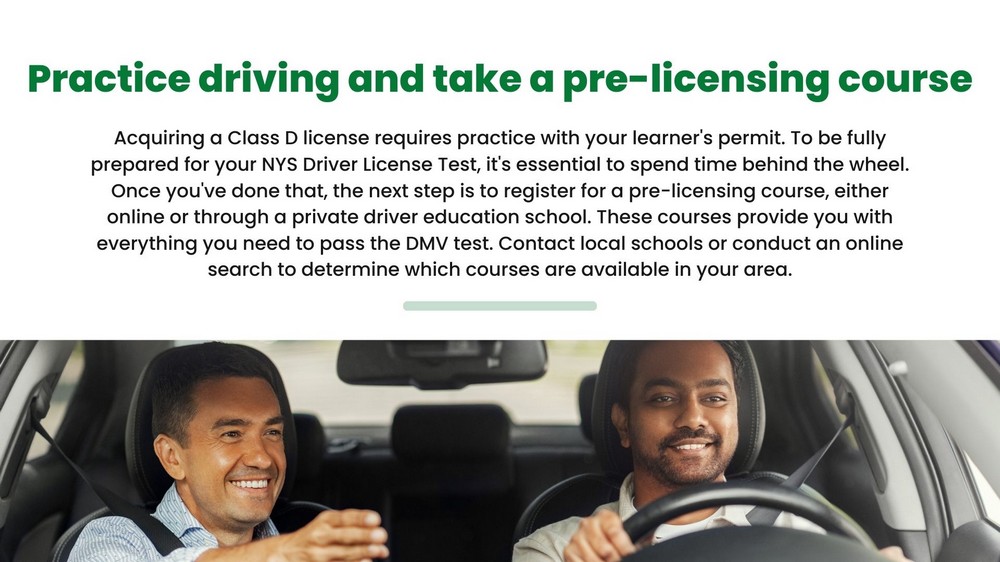
Arrive 30 minutes early with:
- Valid learner permit
- Pre-licensing course certificate (the original, not a copy)
- Car registration
- Proof of insurance
- Supervising driver with their valid license
The car must have working lights, signals, horn, wipers, and brakes. No check engine lights. No obvious defects. Examiners check this before you even start.
Wear comfortable shoes. I've seen people fail because they showed up in flip-flops or high heels and couldn't feel the pedals properly. Sneakers work best.
What Actually Happens During the Test
Minutes 0-5: Pre-inspection The examiner walks around checking your car's lights, signals, and horn. You'll demonstrate wipers, defroster, and emergency brake. Any defect here and the test gets cancelled before it starts.
Minutes 5-22: On-road driving You'll drive through residential streets, make turns at traffic lights, change lanes on a multi-lane road, and possibly enter/exit a highway. The examiner watches how you handle real traffic.
Minutes 22-30: Maneuvers Parallel parking is the big one. You'll also do either a three-point turn or K-turn, plus backing up straight. This is where most people fail.
Minute 30: Immediate results You find out right away if you passed. If you failed, the examiner hands you a score sheet showing exactly what went wrong.
The examiners look for smooth, confident driving. Proper signal use every single time. Head checks when changing lanes so they can see you're checking blind spots. Following the speed limit exactly-going 27 in a 25 zone can cost you points.
Common fail reasons from my 500+ students:
- Hit the curb or parked more than 18 inches away during parallel parking
- Didn't turn head to check blind spot (even if you checked mirrors)
- Rolled through stop signs instead of coming to complete stops
- Went 5+ mph over the residential speed limit
- Nervous over-corrections causing jerky steering
Drive like your grandmother's in the passenger seat. Slow, careful, by the book. Exaggerate your head movements so the examiner can clearly see you're checking. In your mind, narrate each action: "Stop sign ahead, coming to complete stop, checking left, checking right, now proceeding."
If You Fail
Don't panic. About 40% fail their first attempt. You're not alone. The examiner gives you a detailed score sheet showing your exact mistakes. Study that sheet, practice those specific skills for 1-2 weeks, then book a retest.
Each retry costs $10. There's no limit on attempts. I've had students pass on their fifth try who are now safer drivers than some who passed first time. The process matters more than the speed.
Special Situations Worth Knowing
For Immigrants: The Green Light Law
Since December 2019, you can get a New York driver's license without a Social Security Number. It's called a "Standard" license and over 500,000 immigrants have gotten them.
You'll sign an affidavit stating you don't have an SSN, then provide foreign ID documents (passport, consular ID, foreign driver's license) plus proof you live in New York. The DMV cannot share your information with immigration enforcement. That's written into state law.
The license is marked "Not for Federal Purposes" which means you can drive legally anywhere in the United States, but you can't use it to board domestic flights. You'd need your passport for that. For detailed information about the process and requirements, check out our guide for immigrants getting a NY driver's license.
The written test is available in Spanish, Chinese, Russian, Bengali, Arabic, and 15+ other languages. Just ask at the DMV.
Moving from Another State
If you're moving to New York with a valid out-of-state license, you have 30 days to exchange it for a NY license. The good news: if you've had your license for 6+ months, you'll likely skip the road test. You still need to pass the vision test and pay the license fee.
Bring your out-of-state license (valid or expired less than 24 months), proof of NY residency, and your Social Security card to any DMV office. No appointment needed for this.
Different License Classes
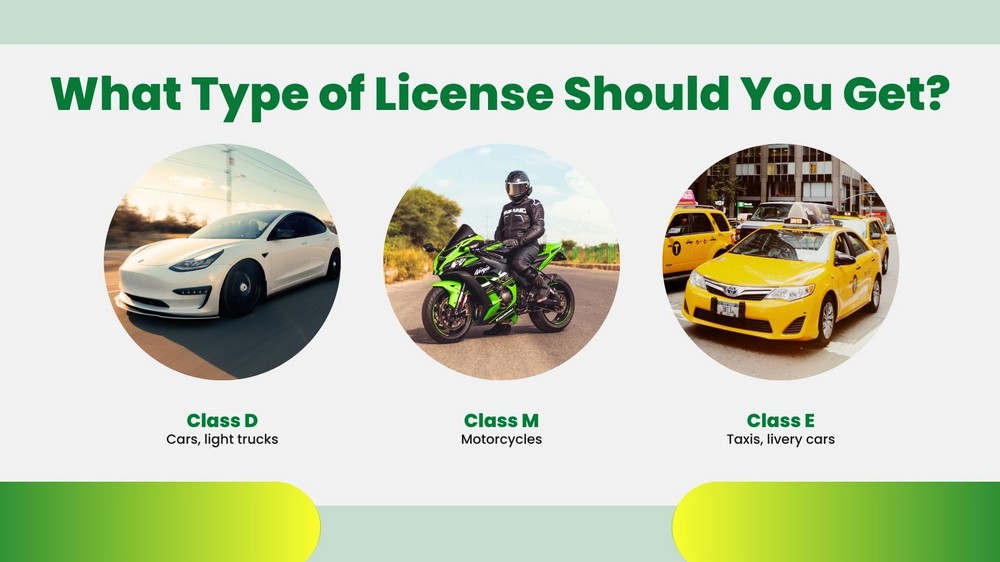
Most people need a Class D license for regular cars and light trucks. But New York offers several classes:
- Class D: Standard passenger vehicles (what you're probably getting)
- Class M: Motorcycles
- Class E: Taxis and livery vehicles (requires additional TLC license)
- CDL (A, B, C): Commercial vehicles like trucks and buses
For more details on different license types, we have a full breakdown. If you're interested in becoming a professional driver, that's a separate process with different requirements.
After Passing: Getting Your License Card
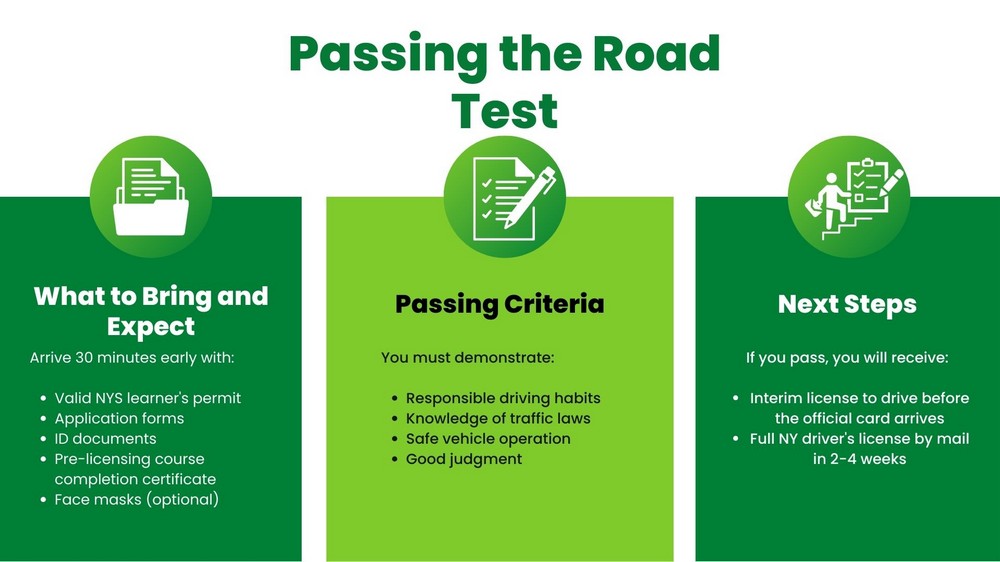
When you pass the road test, the DMV hands you an interim paper license. This is a legal document that lets you drive immediately. Your official card arrives by mail in 2-4 weeks.
Most licenses arrive within 14 days. If you don't receive it in 30 days, call DMV at (518) 486-9786. There's no tracking number, unfortunately.
Your first license is valid for 5 years. After that, you'll renew every 10 years. The DMV mails a reminder 2 months before expiration. You can renew online, by mail, or in person. No road test required for renewals, just a vision check.
All new drivers enter a 6-month probationary period where traffic violations carry harsher penalties. Keep your record clean during this time. If you're under 18, additional restrictions apply-read our guide on junior licenses for details.
Expert Tips from the Road
After teaching hundreds of students, here's what actually makes a difference:
Don't wait too long between permit and road test. Skills get rusty after 6+ months. The sweet spot is finishing the whole process in 3-4 months.
Practice in the actual test area. Every DMV location has routes they use repeatedly. Drive those streets 10+ times before test day. You'll recognize intersections and know where the tricky parts are.
Consider professional lessons even if a friend/parent is teaching you. At least 5 lessons with a pro helps unlearn bad habits before they become muscle memory. Many students do basics with family, then polish with an instructor.
Schedule your road test the day you get your permit. Appointments book 2-3 months out in busy areas. Get your spot early.
Use the same car for practice and the road test. Muscle memory is vehicle-specific. Switching cars at the last minute is a common reason people fail.
Your License Journey Starts Now
Getting your New York driver's license takes commitment, but it's simpler than most people think. The process: get your permit, complete required training, practice 50+ hours, pass the road test, receive your license card. Budget 6-12 months and $268-550.
Start today by downloading the NY Driver Manual and reading it this week. Schedule time to visit the DMV next week for your permit. The sooner you begin, the sooner you're driving independently.
Millions of New Yorkers have done this before you. Follow this guide step-by-step and you'll join them. If you want professional help preparing for your road test, our certified instructors have guided 500+ students to success.
Call Us Today 6AM-10PM

Or fill out the form 24/7
Our team is here to guide you with promotions, instructor availability, and the best training package for you.
Ready to get started? Book your first driving lesson or call us at (646) 980-33-13. Your license is waiting.
Call Us Today 6AM-10PM
Or fill out the form 24/7
Our team is here to guide you with promotions, instructor availability, and the best training package for you.
Frequently Asked Questions
-
How long does the whole process take?
For most people, the full process takes 6–12 months. The minimum possible time is 6 months if you’re under 18 (due to the permit holding period), or about 3 months if you’re 18+. Trying to rush usually backfires — it’s better to give yourself enough time to practice properly.
-
Can I get a license without a Social Security Number?
Yes. Under New York’s Green Light Law, you can apply for a Standard driver license by signing an affidavit and providing foreign identity documents. The license works fully for driving but cannot be used for domestic flights.
-
What if I fail the road test?
You pay a $10 fee and schedule a retest. The examiner will explain exactly what you did wrong. Focus on those specific skills and practice for 1–2 weeks before trying again. Most people pass on their second or third attempt.
-
How much does it really cost?
Plan on a total budget of about $268–550. This includes permit fees ($88.50–107.50), the pre-licensing course ($40–60), and driving lessons ($400–700 if you take them). The license itself is inexpensive, but preparation costs add up.
-
Can I use a rental car for my road test?
Yes, but the car must have valid registration and insurance, and you must be listed as an authorized driver. You should also have at least 5 hours of practice in that exact car. Many people fail because they test in an unfamiliar vehicle — using the car you practiced in is strongly recommended.
-
Do I need to take the road test if I have an out-of-state license?
Usually no, as long as you have been licensed for 6 months or more. You will still need to pass a vision test and pay the required fees, but the road test is typically waived. Visit any DMV office to exchange your license and learn more about getting a New York license with an existing out-of-state credential.