 English
 Spanish
 Callback
How to Schedule a Road Test in NY: Complete 2026 Guide

Table of Contents
- Why the DMV Road Test Is Important
- Eligibility Requirements Before Scheduling
- Complete the 5-Hour Pre-Licensing Course
- How to Schedule Your Road Test in NY
- Choosing the Right Road Test Location
- Road Test Fees and Payment
- How to Reschedule or Cancel Your Road Test
- Preparing for Your Road Test Day
- What to Expect During the Road Test
- Common Mistakes to Avoid During the Road Test
- Getting Your Road Test Results
- If You Pass the Road Test
- If You Fail the Road Test
- Tips for Scheduling Success
- Special Considerations and Additional Information
- Helpful Resources and Next Steps
- You're Ready to Schedule Your Road Test
Getting your driver's license in New York starts with one crucial step: scheduling your DMV road test. Whether you're a teen eager to hit the road or an adult finally taking the plunge, understanding the scheduling process can save you weeks of frustration and get you behind the wheel faster.
The process is straightforward when you know what to expect. Visit the official NY.gov DMV website, gather your learner permit and pre-licensing course certificate, and book your appointment online. The entire scheduling system runs through the state's official portal, where you'll enter your DMV ID number, choose your preferred test location using a ZIP code, and select from available time slots.
Here's what you'll need to get started:
- A valid New York State learner permit with your DMV ID number
- An original, unexpired Pre-Licensing Course Certificate (MV-278) or Student Certificate of Completion (MV-285)
- The ZIP code for your preferred road test location
- At least one unused road test (the first two are included with your permit fee)
- A credit or debit card if you need to purchase additional tests
The scheduling window typically opens 3 to 5 weeks out, though during busy summer months and school breaks, you might be looking at up to 10 weeks. Tests run almost exclusively on weekdays, with Saturday slots being extremely rare.
Why the DMV Road Test Is Important
The road test represents the final hurdle between you and the freedom of a New York driver's license. This practical examination evaluates your ability to operate a vehicle safely in real-world conditions, not just on paper. The license examiner will be watching how you handle everything from basic vehicle control to complex traffic situations.
During the test, you'll demonstrate your understanding of traffic laws, defensive driving techniques, and proper vehicle operation. The examiner assesses your parallel parking skills, ability to execute a three-point turn, use of mirrors and blind spot checks, lane positioning, and how well you respond to road signs and traffic signals. These aren't just boxes to check-they're the fundamental skills that keep you and everyone else on the road safe.
Eligibility Requirements Before Scheduling
Before you can book your road test appointment, you need to meet specific requirements that vary based on your age. New York's Graduated Driver License program sets different standards for junior drivers versus adults.
Requirements by Age Group
|
Age Group |
Minimum Permit Holding Period |
Required Supervised Hours |
Night Driving Hours |
Required Documents |
|
Under 18 (Class DJ/MJ) |
6 months |
50 hours |
15 hours |
MV-262, MV-278/MV-285 |
|
18 and Older |
No waiting period |
No specific requirement |
N/A |
MV-278/MV-285 |
The complete eligibility checklist includes:
- Valid New York State learner permit (Class D, DJ, M, or MJ)
- Passed written permit test at a DMV office
- Original 5-hour pre-licensing course certificate (MV-278) or Student Certificate of Completion (MV-285)
- For drivers under 18: Certification of Supervised Driving (MV-262) signed by parent or guardian
- Minimum 50 hours of supervised practice driving with at least 15 hours after sunset (junior permit holders only)
- At least one unused road test available on your permit
Junior permit holders face the strictest requirements. That six-month waiting period exists for a reason-it gives you time to build real driving experience under supervision. The 50-hour practice requirement, with 15 hours specifically at night, ensures you've encountered various driving conditions before taking the test.
Complete the 5-Hour Pre-Licensing Course
Every new driver in New York must complete the 5-hour pre-licensing course before scheduling a road test. This isn't just a bureaucratic formality-it's a comprehensive classroom session designed to fill knowledge gaps that the written test doesn't cover.
The course curriculum focuses on practical aspects of safe driving. You'll study New York State traffic laws in depth, learn defensive driving techniques that can save your life, understand the very real dangers of impaired and distracted driving, and discuss driver responsibility and safety. Instructors cover topics like sharing the road with motorcycles and large trucks, understanding adverse weather conditions, and making smart decisions behind the wheel.
Upon completion, you receive an MV-278 certificate that you'll need for both scheduling and taking your road test. The certificate comes with an expiration date, so don't complete the course too early-typically, finishing it a few weeks before you plan to take your test works best. If you're wondering about road test requirements in more detail, that resource breaks down everything you need.
How to Schedule Your Road Test in NY
The state offers two straightforward methods for booking your road test appointment. Both require the same information and give you access to the same available time slots.
Schedule Online Through the NY DMV Website
Online scheduling gives you the flexibility to book anytime and lets you compare multiple locations and dates at once. The official NY.gov system is user-friendly and typically the fastest way to secure an appointment.
Follow these steps to book online:
- Visit the official NY DMV Road Test Scheduling page
- Gather your required information: DMV ID Number from your learner permit, Pre-Licensing Course Certificate number, and the ZIP code where you want to test
- Click the "Schedule Now" button on the scheduling portal
- Enter your learner permit DMV ID Number (it's located directly above your name on the permit)
- Input your Pre-Licensing Course Certificate number from your MV-278 or MV-285
- Enter the ZIP code of your preferred test location
- Browse the calendar showing available dates and times
- Select your preferred slot from the options displayed
- Review all appointment details carefully
- Confirm your booking and save the confirmation email
The system will send you a confirmation email immediately. Print this confirmation or save it to your phone-you'll want it as a backup on test day. The official scheduling system typically shows availability for the next several weeks, though during peak testing periods, you might need to book further out.
Expect to wait 3 to 5 weeks for an appointment under normal circumstances. During summer months and school breaks, when teen drivers flood the system, that window can stretch to 10 weeks. There's no waiting list, so checking back regularly for cancellations can sometimes land you an earlier spot. If you're looking to schedule your road test faster, there are strategies that can help.
Schedule by Phone
Some people prefer speaking with a real person, especially if they have questions about the process or need to clarify specific requirements. The DMV phone line handles road test scheduling alongside the online system.
To schedule by phone:
- Call 1-518-402-2100
- Available Monday through Friday, 8:00 AM to 4:00 PM (closed on state holidays)
- Have the same documents and information ready as you would for online scheduling
- TDD users can call 711 or 1-800-662-1220 and have the relay operator dial 1-518-486-9786
Phone scheduling works well if you're having technical issues with the website or if you need immediate answers about your specific situation. However, you'll be working with the same availability as the online system shows-calling doesn't give you access to hidden appointments.
What You Need to Schedule
Getting your documents together before you start the scheduling process saves time and prevents frustration. Missing even one piece of information means stopping mid-process and starting over.
Your scheduling checklist should include:
- Valid New York State Learner Permit with your DMV ID Number clearly visible
- Your original, unexpired Pre-Licensing Course Certificate (MV-278) or Student Certificate of Completion (MV-285) with the certificate number
- The 5-digit ZIP code of your desired test location
- Confirmation that you have at least one unused road test available on your permit
- A credit or debit card if you're purchasing additional tests beyond your first two attempts
- A working email address for appointment confirmations
The DMV ID Number is crucial-it's a 9-digit number that appears above your name on your learner permit. Don't confuse it with your document number or any other numbers on the permit. Finding detailed information about New York DMV appointments can clarify what to expect from the booking process.
Call Us Today 6AM-10PM

Or fill out the form 24/7
Our team is here to guide you with promotions, instructor availability, and the best training package for you.
Choosing the Right Road Test Location
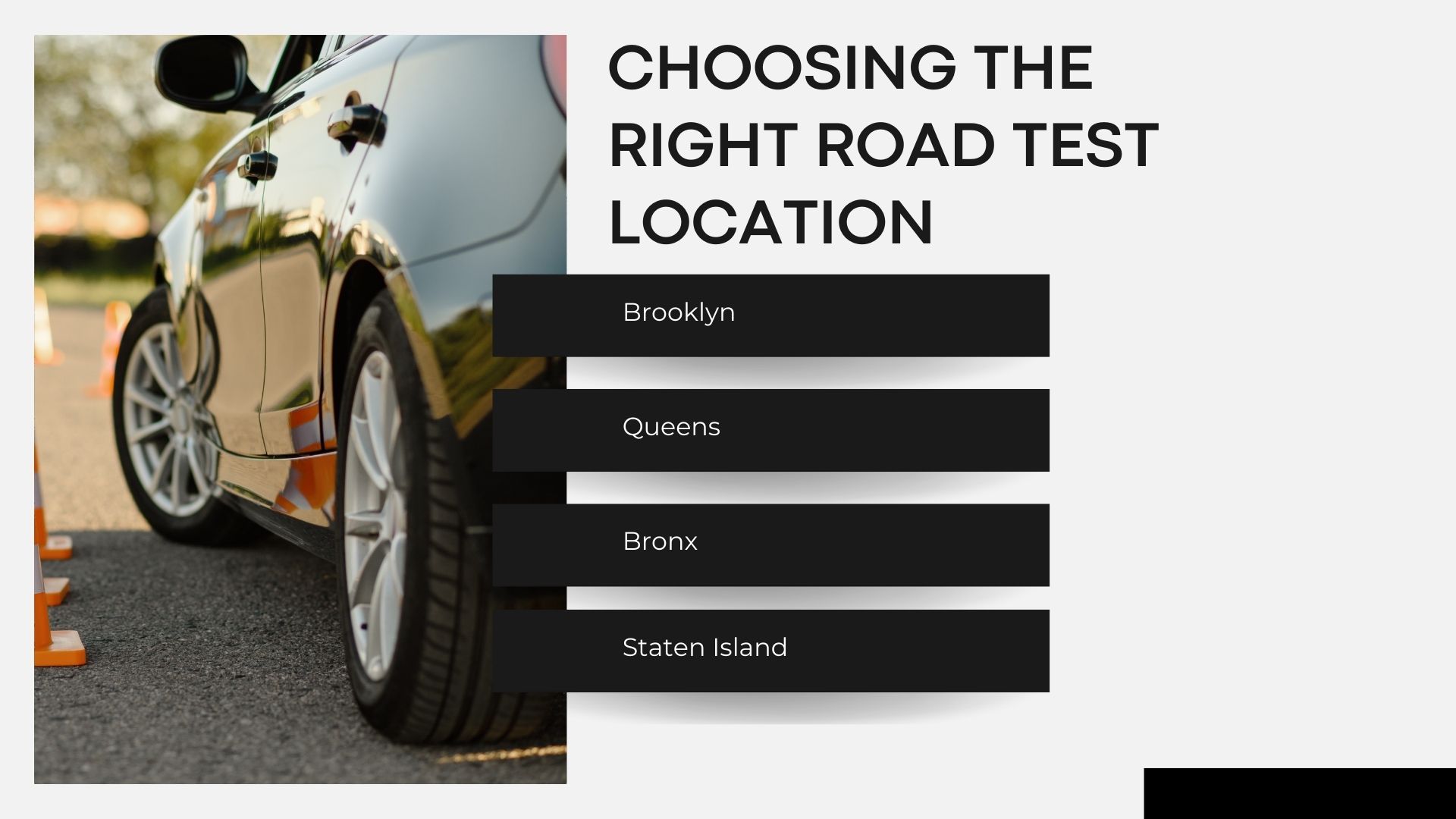
Where you take your road test matters more than you might think. Familiarity with the area gives you a significant advantage, which is why many experienced instructors recommend testing where you've practiced most.
The key is choosing a location where you've logged significant practice hours. If you've spent weeks driving around a particular neighborhood, you already know the traffic patterns, common hazards, and tricky intersections. That familiarity translates to confidence during your test.
Popular Road Test Locations in NYC and Long Island
|
Borough/Area |
Test Site Names |
Key Characteristics |
|
Brooklyn |
Beverly Road, Starrett City, Seaview Avenue |
Varying difficulty levels; Coney Island and Red Hook also available |
|
Queens |
Jamaica, Ozone Park, College Point |
Moderate traffic, diverse road types |
|
Bronx |
Zerega Avenue, Riverdale |
Mix of residential and commercial areas |
|
Staten Island |
Father Capodanno Boulevard |
Generally less congested |
|
Long Island |
Hauppauge, Garden City Park |
Suburban driving conditions |
Brooklyn offers several testing locations with different characteristics. The Beverly Road testing site is popular with local students, while Coney Island and Red Hook each present their own challenges and advantages.
You're not restricted to testing in your home county or borough. If you've been taking lessons in Manhattan but feel more comfortable with the roads in Queens, schedule your test in Queens. The license you receive is valid throughout New York State regardless of where you tested.
Road Test Fees and Payment
Understanding the fee structure helps you budget appropriately and avoid surprises during the scheduling process.
The cost is actually quite reasonable. Your initial learner permit fee includes your first two road test attempts at no additional charge. This gives you two chances to pass without worrying about extra costs. If you need a third attempt or beyond, you'll purchase additional tests in pairs for $10, which covers two more attempts.
Fee Structure
|
Test Attempt |
Fee |
Payment Notes |
|
First and second tests |
Included with permit fee |
No additional charge |
|
Third test and beyond |
$10 for two tests |
Must purchase before scheduling |
To pay for additional road tests:
- Visit the official DMV road test page and look for the payment section
- Call 1-518-402-2100 with your payment information ready
- Have your valid learner permit on hand
- Provide your DMV ID Number and date of birth for verification
- Use a credit or debit card (cash and checks aren't accepted for online or phone payments)
The system won't let you schedule a third or subsequent test until you've purchased the additional attempts. Make sure you have no other road tests currently scheduled when buying additional attempts. For a complete breakdown of costs, check out this guide on how much a road test costs in NYC.
How to Reschedule or Cancel Your Road Test
Life happens, and sometimes you need to change your test date. The DMV makes this process relatively painless, whether you need to reschedule for personal reasons or the state cancels due to weather.
You can modify your appointment through the same channels you used to book it. The online scheduling system at NY.gov lets you reschedule or cancel 24/7. Just log in with your learner permit information and follow the prompts. Alternatively, call 1-518-402-2100 during business hours to reschedule by phone.
Give yourself as much notice as possible when rescheduling. While the system doesn't charge fees for changes, last-minute cancellations waste valuable testing slots that other drivers could use. More importantly, frequent rescheduling can push your next available date further out, especially during busy periods.
The DMV occasionally cancels tests due to bad weather, road construction, or other unforeseen circumstances. Before leaving for your test, check the cancellations and delays page on the DMV website. Nothing's worse than showing up to a closed testing site. If the DMV cancels your test, they'll contact you to reschedule at no charge.
Preparing for Your Road Test Day
Test day preparation starts well before you climb into the driver's seat. Having the right documents and a properly equipped vehicle makes the difference between testing and being turned away.
Required Documents to Bring
Missing even a single document means no test, no exceptions. The license examiner will check everything before allowing you to proceed.
Bring these documents to your road test:
- Your physical photo learner permit (Mobile ID is NOT accepted under any circumstances)
- Original Pre-Licensing Course Certificate (MV-278) or Student Certificate of Completion (MV-285)-photocopies will be rejected
- Certification of Supervised Driving (MV-262) if you're under 18, completed and signed by your parent or guardian
- Prescription glasses or contact lenses if your permit indicates you need corrective lenses
- Your road test appointment confirmation (printed or on your phone)
- A valid physical driver license for your accompanying driver
- Current vehicle registration card
- Proof of insurance for the test vehicle
- Current inspection sticker documentation
The examiner will photograph you, your documents, your learner permit, and the vehicle before the test begins. This is standard procedure for all road tests, so don't be surprised when they ask you to step out of the car briefly.
Vehicle Requirements
Your test vehicle needs to meet specific standards. Examiners will refuse to conduct a test in a car that doesn't comply, and you'll lose that appointment slot.
The vehicle must have:
- Valid New York State registration in good standing
- Current insurance card showing active coverage
- An up-to-date inspection sticker (check the expiration date)
- A clean interior-"reasonably clean" is the official standard
- Properly functioning brakes, lights, turn signals, and horn
- A working emergency brake that the examiner can reach from the passenger seat
- All required mirrors in working condition (both side mirrors and rearview)
- Functional seatbelts for driver and passenger
- No firearms or prohibited items (this is a legal requirement at all DMV facilities)
Rental cars are acceptable if you're listed as an authorized driver on the rental agreement and you meet the minimum age requirements in the contract. Many students use rental cars for road tests when their family vehicle doesn't meet requirements or isn't available on test day.
Driving school vehicles are also permitted and often preferred. These cars are set up specifically for testing, with easily accessible emergency brakes and good visibility. If you've been taking driving lessons with a school, ask about their test day vehicle rental options.
Who Can Accompany You
The person driving with you to the test site must meet specific requirements, and only one person can accompany you-no extra passengers allowed.
Your accompanying driver must be at least 18 years old if they're driving you to the test site, or at least 21 years old if you're driving yourself there for practice. They need a valid physical driver license (again, Mobile ID doesn't count) that authorizes them to operate the type of vehicle you're using for the test.
This person waits while you take your test. They can't ride along during the examination-it's just you and the license examiner in the vehicle. Once the test is complete, your accompanying driver can resume their role.
Arrival and Test Day Timing
Timing your arrival correctly sets the tone for your entire test experience. Show up too early and you're sitting around getting nervous; show up late and you might miss your slot entirely.
Plan to arrive 10 to 15 minutes before your scheduled test time. This gives you a buffer for unexpected traffic or parking challenges while ensuring you're ready when the examiner calls your name. If you arrive late, the examiner may not be able to conduct your test, and you'll forfeit that appointment.
Not all road test locations have indoor waiting areas or shelters. Check the weather forecast and dress appropriately. If it's raining, you might be waiting outside. If it's cold, wear layers. The test must go on unless conditions become dangerous enough for the DMV to cancel.
Before leaving home, visit the DMV website one more time to check for any last-minute cancellations or delays at your test site. Weather can change quickly, and the DMV updates their cancellation list throughout the day.
What to Expect During the Road Test
The actual driving test takes about 10 to 15 minutes, though it might feel much longer when you're behind the wheel. The examiner will direct you through various maneuvers while observing your driving skills and decision-making.
You'll demonstrate several core competencies. Parallel parking is almost always included-you'll need to park your vehicle between two road markers or behind another vehicle without hitting anything. The three-point turn (also called a K-turn) tests your ability to reverse direction on a narrow street. Throughout the test, the examiner watches how you use your mirrors and check your blind spots before changing lanes or merging.
Other evaluated skills include:
- Smooth acceleration and controlled braking without jerking the vehicle
- Proper lane positioning and safe lane changes with appropriate signaling
- Obeying all traffic signs, signals, and pavement markings
- Correct turning technique with proper hand positioning and signaling
- Maintaining appropriate speed for conditions without exceeding limits
- Yielding right-of-way at intersections, crosswalks, and when merging
- Coming to complete stops at stop signs and red lights
- Proper observation at intersections before proceeding
Modern vehicles often come with backup cameras and parking sensors, and you're allowed to use these during your test. The DMV recognizes that most new cars have these features, so they're not considered unfair advantages. However, you still need to physically turn your head to check blind spots-the cameras supplement your vision but don't replace proper observation techniques.
The examiner sits quietly for most of the test, giving you directions like "turn right at the next intersection" or "pull over and parallel park behind that vehicle." They're not trying to trick you-follow their instructions while obeying all traffic laws, and you'll do fine.
Call Us Today 6AM-10PM
Or fill out the form 24/7
Our team is here to guide you with promotions, instructor availability, and the best training package for you.
Common Mistakes to Avoid During the Road Test
Certain errors appear again and again on failed road tests. Knowing what examiners look for helps you avoid these pitfalls.
The most common mistakes include:
- Rolling through stop signs instead of coming to a complete stop with the vehicle fully motionless
- Forgetting to check mirrors or blind spots before lane changes, turns, or merging
- Failing to signal lane changes, turns, or when pulling away from the curb
- Hitting the curb, markers, or another vehicle during parallel parking
- Driving significantly below the speed limit when conditions don't warrant it, or exceeding the limit even by a few miles per hour
- Improper hand positioning on the steering wheel (keep both hands on the wheel)
- Not yielding to pedestrians in crosswalks or at intersections
- Disregarding traffic signs or signals, even momentarily
- Excessive nervousness that affects basic vehicle control
- Poor observation at intersections-not looking both ways before proceeding
Many of these mistakes happen when students get nervous and revert to bad habits. Regular practice with professional driving lessons helps you build muscle memory for correct techniques. When these skills become automatic, they'll stay with you even under the pressure of a test.
Getting Your Road Test Results
The waiting game begins as soon as you return to the testing site after your drive. The examiner won't tell you immediately whether you passed or failed-instead, they'll direct you to check your results online.
Your results post to the official results website after 6:00 PM on the day of your test. Visit roadtestresults.nyrtsscheduler.com and enter your information to see whether you passed. This system replaced the old method of receiving results on paper at the test site, which caused delays and sometimes lost paperwork.
If You Pass the Road Test
Passing your road test triggers an immediate change in your driving privileges. You're no longer restricted to supervised driving-you can get on the road independently right away.
You'll receive an interim license online the same day your results post. This digital document serves as your temporary license and must be kept with your photo learner permit whenever you drive. Together, these two documents prove you're a licensed driver. Your official photo driver license arrives by mail within about two weeks.
New drivers enter a probationary period regardless of age. This period comes with additional restrictions and consequences for violations. For drivers under 18 with a Class DJ or MJ license, the Graduated Driver License law imposes further limitations on when you can drive and who can be in your vehicle.
Junior drivers face specific GDL restrictions:
- Limited nighttime driving hours depending on your age and how long you've held the license
- Restrictions on the number of passengers under 21 (except family members)
- Enhanced penalties for traffic violations during the probationary period
- Additional requirements if you want to upgrade to an unrestricted license
These restrictions exist to protect new drivers during their highest-risk period. Statistics show that newly licensed drivers, especially teens, face elevated crash risks during their first months of independent driving. The GDL system gradually removes restrictions as you gain experience.
If You Fail the Road Test
Failing your road test isn't the end of the world-it's a learning opportunity. Your learner permit stays valid until its expiration date, so you don't need to start the entire process over.
You must wait at least 14 days before taking the test again. This cooling-off period gives you time to practice the specific skills where you struggled. The examiner's feedback, while brief, usually indicates what went wrong. Use those two weeks to address those weaknesses.
Scheduling your next test follows the same process as before. Log into the online scheduling system or call the DMV to book another appointment. Remember that if you've now failed your first two attempts, you'll need to purchase additional tests before scheduling. The $10 fee covers two more attempts.
Many students benefit from additional driving lessons between attempts. A professional instructor can identify subtle problems you might not notice yourself and provide targeted practice on the maneuvers that cost you points. Even a single lesson focused on your weak areas can make the difference between failing again and passing confidently. Our comprehensive road test preparation services help students succeed on their next attempt.
Tips for Scheduling Success
Smart scheduling strategies can significantly improve your testing experience and increase your chances of success.
Start by booking as early as possible. During peak periods like summer vacation and school breaks, appointment slots fill up weeks or even months in advance. The earlier you schedule, the more options you have for location, date, and time. Some students find success monitoring the system for cancellations-when someone reschedules, their slot becomes available immediately.
Choose your test location strategically. Pick a site where you've practiced extensively and feel comfortable with the roads, traffic patterns, and common challenges. Don't just schedule at the closest location if you're unfamiliar with the area. Testing somewhere you've never driven adds unnecessary stress.
Additional scheduling tips:
- Avoid peak testing periods if possible-mid-fall and early spring tend to be less busy than summer
- Double-check all your documents several days before the test to ensure nothing has expired
- Practice during similar weather conditions and times of day as your scheduled test
- Use only the official NY.gov scheduling site-third-party sites charge fees and aren't affiliated with the DMV
- Consider weekday appointments (Saturday tests are rare and fill up instantly)
- Schedule your test for a time when you typically feel alert and focused
- Build in extra travel time to account for traffic on test day
Getting your test scheduled efficiently sets you up for success, but the real work happens during those practice hours leading up to test day.
Special Considerations and Additional Information
A few special circumstances and rules apply to road testing that don't fit neatly into other categories but are still important to know.
If your vehicle has Advanced Driver Assistance Systems (ADAS) like automatic emergency braking, lane departure warnings, or adaptive cruise control, review the DMV's guidelines for testing with these systems. Some features may need to be disabled during the test, while others are acceptable. The examiner needs to evaluate your driving skills, not the car's automation capabilities.
Practice driving is strictly prohibited at New York State test sites. Don't arrive early thinking you'll get a quick practice session in the parking lot or on nearby streets where examiners typically conduct tests. This is explicitly forbidden and could result in being asked to leave or having your test cancelled.
As of April 20, 2022, three-wheeled motor vehicles with two wheels in the front, one in the rear, a steering mechanism, non-straddle seating, and safety belts cannot be used for road tests. This rule came about due to safety and standardization concerns. Stick with a traditional four-wheeled vehicle for your test.
Call Us Today 6AM-10PM
Or fill out the form 24/7
Our team is here to guide you with promotions, instructor availability, and the best training package for you.
Frequently Asked Questions
-
How much does it cost to take the DMV road test in NY?
Your first two road test attempts are included in your learner permit fee. After that, you pay $10 for two additional attempts (third and fourth).
-
How far in advance should I book my road test in New York?
Book as soon as you are eligible. Availability is usually 3–5 weeks out, but during peak seasons it can be up to 10 weeks. You can always reschedule later.
-
Can I use my own car for the road test?
Yes. Your car must have valid NY registration, insurance, inspection, be in safe condition, and have an accessible emergency brake for the examiner.
-
What if I don't have a car for the road test?
You may use a rental car if you are an authorized driver. Many driving schools also offer road test car rentals, often with a pre-test lesson.
-
Is the 5-hour pre-licensing course mandatory?
Yes. All new drivers must complete the 5-hour course and obtain the MV-278 certificate. There are no exceptions.
-
How long is the road test in NY?
The driving portion lasts about 10–15 minutes. Expect 30–45 minutes total including paperwork and instructions.
-
Can I take the road test in a different county?
Yes. You may take the test in any county in New York. Your license is valid statewide regardless of test location.
-
What happens if I'm late to my road test?
If you are late, the examiner may not be able to test you. You will need to reschedule, so arrive 10–15 minutes early.
-
How many times can I fail the road test?
There is no limit while your learner permit is valid. You must wait 14 days between attempts and pay after the first two failures.
-
Can I use a rental car for my NY road test?
Yes, if you are listed as an authorized driver and meet the rental age requirements. Always confirm this with the rental company in advance.
-
Do I need to parallel park on the NY road test?
Yes. Parallel parking is included in almost every NY road test. The examiner will explain the requirements before you begin.
-
Can I reschedule my road test for free?
Yes. You can reschedule or cancel for free using the DMV system. Try to do it early, especially during busy seasons.
Helpful Resources and Next Steps
The New York DMV provides numerous resources to help you prepare for and schedule your road test. Taking advantage of these official materials gives you the best chance of success.
Essential resources include:
- Official NY State Road Test Scheduling Portal for booking appointments
- The Driver License Manual (MV-21) in PDF format, which covers all rules and procedures
- An interactive map to find road test locations throughout the state
- The DMV Office Locator to find the nearest DMV office for other services
- A video guide on preparing for the Class D road test
- Phone support at 1-518-486-9786 for general DMV assistance
- The Road Test Results Portal to check your pass/fail status after testing
Beyond official DMV resources, consider investing in professional instruction. Certified driving instructors know exactly what examiners look for and can provide targeted feedback on your driving. Even students who've practiced extensively with family members benefit from a few professional lessons before their test.
You're Ready to Schedule Your Road Test
Booking your New York road test really comes down to three things: meet the requirements, get your documents together, and schedule through the official DMV system. That's it.
Take the prep work seriously. Finish that 5-hour course, put in real practice time, and make sure you know the roads around your test location. Double-check that your paperwork and vehicle are good to go. Students who pass on the first try aren't lucky-they're just prepared.
The scheduling system is open right now. You've got all the information you need to book with confidence. Your driver's license is waiting.