 English
 Spanish
 Callback
Is Running a Red Light a Point on Your License in New York?

Table of Contents
- Understanding Red Light Violations in New York
- Do Red Light Tickets Add Points to Your License? The Critical Difference
- How Red Light Violations Impact Your Driving Record in New York
- Penalties and Fines for Running a Red Light in NY
- Red Light Violations by the Numbers: NY Data & Statistics
- Legal Defenses for Red Light Tickets in New York
- How to Reduce or Remove Points from Your Driving Record
- Out-of-State Red Light Violations and NY Record
- What to Do If You Receive a Red Light Ticket in NY
- Preventing Red Light Violations: Tips for NY Drivers
- The Bottom Line on Red Light Tickets and Your Driving Record
Getting pulled over for running a red light is one of the most common tickets in New York. Last year alone, police issued over 184,000 tickets for disobeying traffic signals. If you just got one, you're probably wondering: will this add points to my license?
The answer depends on how you got caught. If a police officer pulled you over, expect 2-3 points on your record. If a camera caught you, it's zero points. That difference matters-a lot-for your insurance rates, your driving record, and how much this violation will actually cost you.
This guide covers everything you need to know about red light tickets in New York: how points work, what the penalties are, and how to protect your driving record. Whether you're a new driver with a provisional driving license or you've been driving for years, understanding these rules could save you serious money and hassle.
Understanding Red Light Violations in New York
New York law treats red light violations seriously, but not all tickets are created equal. According to Section 1111(d) of the Vehicle and Traffic Laws, drivers must come to a complete stop at a clearly marked stop line when facing a red light. If there's no stop line, you need to stop before entering the crosswalk. No crosswalk? Stop at the point nearest the intersection where you can see approaching traffic.
The state prosecutes red light violations under two different sections of the Vehicle and Traffic Law. VTL 1110a covers "failing to obey a traffic control device," which is the broader violation that includes running red lights. VTL 1111(d)-1 specifically addresses "passing a red light" and carries different penalties depending on where the violation occurred.
Here's how these violations stack up against each other:
|
Violation Type |
Points Added |
Base Fine |
Surcharge |
Maximum Jail Time |
|
VTL 1110a (Disobeying Traffic Control Device) |
2 |
Up to $150 |
$80-$85 |
Up to 15 days |
|
VTL 1111(d)-1 (Outside NYC) |
3 |
Up to $225 |
$80-$85 |
Up to 15 days |
|
VTL 1111(d)-1 (NYC & Cities 1M+) |
3 |
Up to $450 |
$80-$85 |
Up to 15 days |
|
Red Light Camera Violation |
0 |
$50 |
$4 processing |
None |
Understanding which violation you're charged with matters because it directly impacts your driving record and insurance premiums.
Do Red Light Tickets Add Points to Your License? The Critical Difference
The answer to whether a red light ticket adds points depends on one crucial factor: who (or what) caught you.
Officer-Issued Red Light Tickets
When a police officer personally witnesses you running a red light and pulls you over, you're facing real points on your license. The officer will typically write the ticket under VTL 1110a or VTL 1111(d)-1, and both violations result in a conviction on your driving record.
If you're charged under VTL 1110a for disobeying a traffic control device, you'll receive 2 points on your license after conviction. The fine reaches up to $150, plus an additional surcharge between $80 and $85. While 2 points might not sound catastrophic, they add up quickly when combined with other violations. For new drivers navigating teen driving restrictions, even these 2 points can create serious problems.
The more common charge for running a red light is VTL 1111(d)-1, which adds 3 points to your driving record. Outside New York City, the fine reaches $225 plus surcharges. Inside NYC and other cities with populations exceeding one million, that fine jumps dramatically to $450-nearly double. Officers sometimes issue both violations for a single incident, arguing that your behavior violated multiple traffic laws simultaneously.
Key facts about officer-issued tickets:
- Points are added only after conviction, not when the ticket is issued
- The violation date matters for point calculations, not the conviction date
- Fines vary significantly based on location (NYC vs. rest of state)
- Both violations carry the possibility of up to 15 days in jail for extremely dangerous circumstances
Red Light Camera Tickets
Red light cameras tell a completely different story. These automated enforcement systems capture vehicles entering intersections after the signal turns red, using sensors synchronized with traffic lights. When triggered, the camera captures both still photographs and video footage showing your vehicle, license plate, and the exact time elapsed since the light changed.
Here's the critical difference: red light camera tickets add zero points to your driving record. The ticket goes to the vehicle's registered owner, regardless of who was actually driving. Because the camera only captures the license plate and can't identify the driver, New York intentionally keeps these penalties minimal to avoid constitutional challenges.
Camera tickets carry a flat $50 fine plus a $4 processing fee. If you pay by credit card, expect an additional 2% service fee. Your insurance company never gets notified about camera violations, which means your premiums stay untouched. This is why many drivers simply pay camera tickets and move on-though that's not always the best strategy, as we'll discuss later.
Important camera ticket facts:
- The violation notice arrives by mail within 30 days
- Photos show your vehicle crossing the crosswalk while the light is red
- A second photo captures your vehicle past the intersection
- A close-up shot documents your license plate
- Zero points mean zero impact on your driving record
- Insurance companies don't receive notification
Call Us Today 6AM-10PM

Or fill out the form 24/7
Our team is here to guide you with promotions, instructor availability, and the best training package for you.
How Red Light Violations Impact Your Driving Record in New York
Understanding New York's point system is essential for every driver, especially if you're learning to drive or preparing for your road test.
The NY Point System Explained
The Driver Violation Point System gives the DMV a way to identify and take action against high-risk drivers. Each traffic violation carries a specific point value, and those points accumulate on your driving record. The DMV calculates your point total based on the violation date-not when you were convicted or when you paid the fine.
Points for violations occurring within the last 18 months are added together to determine your current total. Once 18 months pass from the violation date, those points no longer count toward your active total. However, here's the catch: the conviction itself remains on your driving record much longer, and insurance companies can access that information.
Two critical thresholds every New York driver needs to know:
- 6 points in 18 months triggers a Driver Responsibility Assessment fee of $300, plus $75 for each additional point beyond six
- 11 points in 18 months can result in license suspension
If you're already dealing with points from other violations, a 3-point red light ticket could push you over these limits. For drivers who have struggled with failing their driving test multiple times, understanding these thresholds becomes even more critical before getting on the road.
How Long Do Red Light Tickets Stay on Your Record?
The timeline for red light violations gets confusing because there are actually two different clocks running simultaneously.
For point calculation purposes, violations expire after 18 months from the date you committed the offense. This means if you got a red light ticket on January 1, 2024, those points stop counting toward your total on July 1, 2025. You won't accumulate new Driver Responsibility Assessment fees based on these expired points, and they won't count toward the 11-point suspension threshold.
However-and this is crucial-the conviction itself remains on your driving record much longer. The New York DMV keeps these records for years, and insurance companies regularly pull them when calculating your premiums. So while the points might stop affecting your license status after 18 months, they can continue affecting your insurance rates for several years.
Insurance companies operate their own point systems completely separate from the DMV. They review your driving record during policy renewals and rate adjustments, typically looking back three to five years. A red light conviction from two years ago might not add to your DMV point total anymore, but your insurance company can still use it to justify higher premiums.
Can Red Light Tickets Suspend Your License?
Yes, red light tickets can absolutely lead to license suspension, though it depends on the type of ticket and your overall driving record.
For officer-issued red light tickets, suspension becomes a real threat when you accumulate 11 or more points within 18 months. Since a single red light violation adds 2-3 points, you'd need additional violations to reach suspension territory. But if you're already carrying points from speeding, improper lane changes, or other moving violations, that red light ticket could be the one that pushes you over the edge.
Red light camera tickets work differently. While they don't add points, New York has implemented a different penalty structure for repeat camera offenders. If you receive five or more red light camera violations within a 12-month period, the DMV may require you to complete a safe driving course. Failure to complete this course can lead to vehicle impoundment-they won't suspend your license, but they'll take your car.
License suspension scenarios include:
- Accumulating 11+ points from multiple officer-issued tickets over 18 months
- Combining a red light violation with other moving violations to reach 11 points
- Failing to complete the required driving course after 5+ camera violations in one year
- Ignoring unpaid red light fines, which can lead to registration suspension and prevent renewal
For drivers holding a foreign license trying to navigate New York roads, these suspension rules apply equally-accumulating violations can jeopardize your driving privileges in the state.
Penalties and Fines for Running a Red Light in NY
The financial impact of a red light ticket extends well beyond the initial fine printed on your ticket.
Officer-Issued Ticket Penalties
When an officer pulls you over for running a red light, you're facing a layered penalty structure that includes fines, surcharges, and potential long-term costs. Here's the complete breakdown:
|
Violation Code |
Maximum Fine |
NYS Surcharge |
Points |
Possible Jail Time |
|
VTL 1110a |
$150 |
$80-$85 |
2 |
Up to 15 days |
|
VTL 1111(d)-1 (Outside NYC) |
$225 |
$80-$85 |
3 |
Up to 15 days |
|
VTL 1111(d)-1 (NYC/Cities 1M+) |
$450 |
$80-$85 |
3 |
Up to 15 days |
The total immediate cost for a red light ticket in NYC can reach $535 when you combine the maximum fine with surcharges. But that's just the beginning. Once points land on your record, your insurance company will likely increase your premiums. Industry data shows that a single red light violation can raise insurance rates by 20-30% for three to five years. On an average New York auto insurance policy of $2,000 per year, that's an additional $400-$600 annually-potentially $2,000+ in extra costs over time.
If you accumulate 6 points within 18 months, add another $300 for the Driver Responsibility Assessment fee, plus $75 for each point beyond six. A driver with a previous speeding violation (4 points) who then gets a red light ticket (3 points) would owe $375 in assessment fees alone.
Red Light Camera Penalties
Camera violations follow a completely different timeline and fee structure. When the camera captures your violation, the process unfolds like this:
Days 1-30: You receive a Notice of Liability in the mail showing photographic evidence. The fine is $50 plus a $4 processing fee. Pay by credit card and add another 2% ($1.08 on a $54 payment).
Days 31-60: If you ignore the initial notice, a second notice arrives with an additional $25 penalty, bringing your total to $79.
Days 61-75: A final notice gets mailed warning of impending enforcement action.
Day 75+: The city or county can begin enforcement proceedings, which may include preventing vehicle registration renewal or even registration suspension. You can't renew your registration with outstanding camera violations, effectively sidelining your vehicle until you pay.
Insurance Premium Impact
The insurance consequences of red light tickets split sharply between officer-issued and camera violations. When an officer writes you a ticket, that conviction appears on your driving record during insurance company reviews. Insurers view red light violations as indicators of risky behavior-you're statistically more likely to cause accidents if you run red lights.
Camera tickets, however, remain invisible to insurance companies. Since these violations don't appear on your driving record and carry no points, your insurer never finds out. This is one reason why the fine stays so low-the state knows these tickets can't withstand the same scrutiny as officer-issued citations, so they keep penalties minimal to encourage payment over contestation.
Red Light Violations by the Numbers: NY Data & Statistics
The data on red light violations in New York tells a sobering story about road safety and enforcement trends. According to the Institute of Traffic Safety Management & Research, red light violations have fluctuated significantly over the past decade:
Tickets Issued for Disobeying Traffic Devices (2014-2023):
- 2014: 260,913 tickets
- 2015: 253,088 tickets
- 2016: 275,400 tickets
- 2017: 276,858 tickets
- 2018: 277,639 tickets
- 2019: 269,710 tickets
- 2020: 133,283 tickets (pandemic impact)
- 2021: 138,073 tickets
- 2022: 157,707 tickets
- 2023: 184,833 tickets
The dramatic drop in 2020 reflects pandemic lockdowns and reduced traffic. Since then, violations have climbed steadily as traffic returned to pre-pandemic levels. What's more alarming is the fatality data: 111 people died in crashes caused by disobeying traffic control devices in 2023-the highest annual total recorded in the previous decade. The NYC Department of Transportation notes that all these fatal incidents occurred at intersections without red-light cameras, suggesting that camera enforcement may have a legitimate safety benefit at high-risk locations.
These numbers reinforce why understanding traffic laws matters so much, especially for students preparing for their road test. Red light violations aren't just expensive tickets-they're a leading cause of serious crashes and fatalities across the state.
Call Us Today 6AM-10PM
Or fill out the form 24/7
Our team is here to guide you with promotions, instructor availability, and the best training package for you.
Legal Defenses for Red Light Tickets in New York
Not every red light ticket is unbeatable. Depending on the circumstances and evidence, you may have legitimate grounds to contest the violation.
Defenses for Officer-Issued Tickets
When fighting an officer-issued red light ticket, you have the right to challenge the evidence and testimony against you. Unlike camera tickets, these cases involve a human witness-the officer who observed the violation. Your attorney can cross-examine this witness, questioning their vantage point, the traffic conditions, and what they actually saw.
Common defenses for officer-issued violations include:
- You weren't driving: If someone else was operating your vehicle, you can present evidence showing your whereabouts at the time of the violation (work records, appointment confirmations, timestamps from other locations)
- Officer direction: Police sometimes direct drivers through red lights to clear intersections during emergencies or heavy traffic. If an officer waved you through, this provides a valid defense
- Emergency situation: A medical emergency requiring you to rush to the hospital may justify the violation, though you'll need documentation
- Obstructed view: If the officer's line of sight was blocked by other vehicles, buildings, or road features, they may not have clearly seen your vehicle or the light status
- Traffic signal malfunction: If the light was malfunctioning (stuck on red, displaying contradictory signals, or cycling incorrectly), this undermines the violation
- Yellow light timing: If you entered the intersection while the light was still yellow, you didn't violate the law-even if it turned red while you were in the intersection
Successfully defending against officer-issued tickets often requires gathering evidence quickly. Photographs of the intersection, witness statements, and documentation of your whereabouts can make the difference between conviction and dismissal. Many drivers who master road test requirements find that understanding traffic control devices also helps them build stronger defenses against tickets.
Defenses for Camera Tickets
Red light camera tickets present unique constitutional and evidentiary challenges that make them easier to contest in some ways but harder in others. The U.S. Supreme Court case Melendez-Diaz v. Massachusetts established that photographic evidence is "testimonial" in nature, meaning defendants have the right to confront their accuser. But how do you cross-examine a camera?
This constitutional problem is why camera ticket penalties stay so low in New York. The state knows these tickets face legal vulnerability, so they price them at a point where most people won't bother fighting. But if you choose to contest a camera ticket, several defenses may work:
Strong defenses for camera violations:
- Vehicle or plate not clearly visible: If the photographs don't clearly show your vehicle make, model, or license plate number, the evidence is insufficient
- Medical emergency: Documentation of a genuine medical crisis requiring immediate hospital transport can justify the violation
- Vehicle stolen: If your vehicle was stolen at the time of the violation, a police report proves you weren't responsible
- Not the registered owner: If you sold or transferred the vehicle before the violation date, documentation of the transfer defeats liability
- Multiple vehicles in frame: When several vehicles appear in the photos, it may be unclear which one triggered the camera
- Camera malfunction: Requesting the technician's certification proving the camera operated correctly can reveal maintenance issues or calibration problems
- Traffic light malfunction: If the signal was broken, improperly timed, or malfunctioning when the photo was taken
The photography sequence sent with camera tickets includes specific technical details: the date, time, location, number of seconds since the light turned red, and the lane that triggered the camera. Scrutinize these details carefully. Inconsistencies in timestamps, impossible time sequences, or technical errors can invalidate the ticket.
Is It Worth Fighting a Red Light Ticket?
For camera tickets carrying only a $50 fine and zero points, the cost-benefit calculation tilts toward simply paying in most cases. Taking time off work to appear in court, potentially hiring an attorney, and spending hours on the case rarely makes financial sense for such a small penalty. However, if you believe the ticket was issued in error, the camera malfunctioned, or you have strong evidence on your side, contesting it might be worthwhile on principle.
Officer-issued tickets tell a different story entirely. With 2-3 points at stake, potential insurance increases exceeding $2,000 over several years, and the risk of Driver Responsibility Assessment fees, fighting these tickets makes strong economic sense. A traffic attorney typically charges $300-$500 for representation, but the potential savings in insurance premiums alone often justify this expense many times over.
The decision becomes even clearer if you're already carrying points on your license or approaching the 6-point or 11-point thresholds. In these situations, fighting the ticket isn't just about money-it's about protecting your ability to drive legally. For professional drivers or anyone who depends on their license for work, the stakes are even higher.
How to Reduce or Remove Points from Your Driving Record
If you've already been convicted of a red light violation and points have landed on your record, you're not helpless. New York offers programs to help mitigate the damage.
Point and Insurance Reduction Program (PIRP)
The DMV-approved Point and Insurance Reduction Program (PIRP) provides a way to offset points and reduce insurance costs simultaneously. When you complete an approved PIRP course, you receive two significant benefits that last for 18 months from the completion date.
First, the DMV will subtract up to 4 points when calculating whether your total reaches the 11-point suspension threshold. This is crucial: the points don't physically disappear from your driving record, and they still count toward Driver Responsibility Assessment fees if you've already hit 6 points. But if you're hovering near suspension territory with 9 or 10 points, PIRP can prevent the DMV from pulling your license when the next violation arrives.
Second, you'll receive a mandatory 10% reduction on your automobile liability and collision insurance premiums. Insurance companies must provide this discount by law when you complete PIRP, and it continues for three full years. On a $2,000 annual policy, that's $200 in savings per year, or $600 total-far exceeding the typical $50-$100 course cost.
PIRP course benefits include:
- Up to 4 points subtracted for suspension calculations (if you have 11+ points)
- 10% reduction on liability and collision insurance for three years
- Points remain visible on your record but count for less
- Can be completed online or in-person
- Available once every 18 months
The program works especially well for drivers who accumulated points from multiple violations. If you have a speeding ticket (4 points), a red light violation (3 points), and an improper lane change (3 points), you're sitting at 10 points. Complete PIRP, and the DMV treats you as having only 6 points when calculating suspension risk.
Other Options to Protect Your Record
Beyond PIRP, several strategies can help minimize damage from traffic violations:
- Contest the ticket in court: Even if you don't win outright, prosecutors often negotiate reductions to non-moving violations that carry no points. A skilled traffic attorney might get your 3-point red light ticket reduced to a parking violation or equipment offense.
- Negotiate a plea to a non-moving violation: Traffic courts handle massive caseloads. Prosecutors may offer plea deals where you pay a higher fine in exchange for a violation that doesn't add points to your license. This trade often makes financial sense given insurance implications.
- Complete a defensive driving course: While similar to PIRP, some defensive driving programs satisfy court requirements when offered as part of a plea agreement. The course completion might convince a judge to reduce charges.
- Request traffic school where available: Some jurisdictions offer traffic school options that can prevent points from being added if you complete the program within a specific timeframe.
The key is taking action quickly after receiving a ticket. Deadlines are strict-typically 30 days to respond-and missing them can result in automatic conviction. For drivers who recently passed their Staten Island road test or are still on provisional licenses, protecting that clean record should be a top priority.
Out-of-State Red Light Violations and NY Record
If you're a New York driver who runs a red light in another state, the good news is that most out-of-state convictions don't add points to your New York driving record. The DMV generally doesn't transfer points from other states, which means a red light ticket in New Jersey, Pennsylvania, or Florida won't directly affect your New York point total.
However, two major exceptions exist: Ontario and Quebec. New York maintains reciprocal agreements with these Canadian provinces, meaning traffic violations there are treated exactly as if they occurred in New York State. A red light conviction in Toronto or Montreal gets recorded on your New York driver record with the same point values and consequences as a violation in Manhattan or Buffalo. The conviction can trigger Driver Responsibility Assessment fees and count toward the 11-point suspension threshold.
Important considerations for out-of-state violations:
- Most U.S. state violations don't transfer points to New York
- Ontario and Quebec violations are fully recorded and carry identical consequences
- Insurance companies may still discover out-of-state convictions during record checks
- Some violations can affect your driving privileges through interstate compacts
Even when points don't transfer, your insurance company might find out about out-of-state tickets through national databases. Insurers increasingly use comprehensive background checks that pull violations from multiple states, so don't assume an out-of-state ticket is invisible just because it doesn't add points to your New York record.
What to Do If You Receive a Red Light Ticket in NY
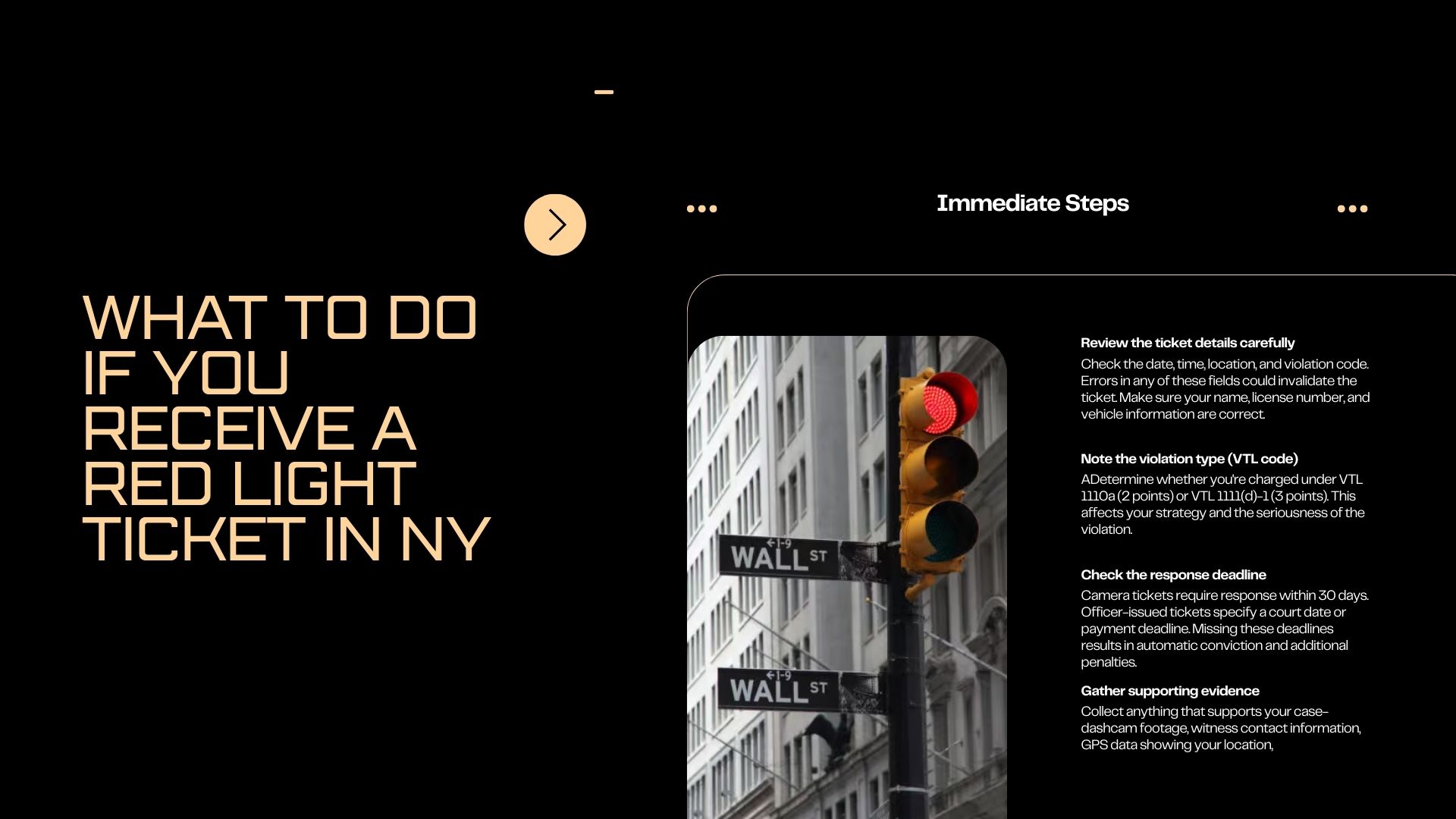
The moment you receive a red light ticket, the clock starts ticking. How you respond in the next 30 days can significantly impact the final outcome.
Immediate Steps
Taking the right actions immediately after receiving a ticket can preserve your options and strengthen your position whether you choose to fight or pay.
- Review the ticket details carefully: Check the date, time, location, and violation code. Errors in any of these fields could invalidate the ticket. Make sure your name, license number, and vehicle information are correct.
- Note the violation type (VTL code): Determine whether you're charged under VTL 1110a (2 points) or VTL 1111(d)-1 (3 points). This affects your strategy and the seriousness of the violation.
- Determine if it's camera or officer-issued: Camera tickets arrive by mail with photographic evidence. Officer tickets are handed to you during the traffic stop. The distinction completely changes your approach.
- Check the response deadline: Camera tickets require response within 30 days. Officer-issued tickets specify a court date or payment deadline. Missing these deadlines results in automatic conviction and additional penalties.
- Document the incident while it's fresh: Write down exactly what happened, including traffic conditions, weather, the signal timing, and any relevant factors. Take photos of the intersection if possible, especially if you believe the signal was malfunctioning or signage was inadequate.
- Gather supporting evidence: Collect anything that supports your case-dashcam footage, witness contact information, GPS data showing your location, or proof you weren't driving the vehicle.
For camera tickets, visit the website listed on the Notice of Liability to view the photographic evidence online. The images show the sequence of your vehicle entering and crossing the intersection. Examine them carefully for any ambiguities or technical problems.
Payment vs. Contesting
Deciding whether to pay or fight a red light ticket depends on several factors:
|
Consider Paying If: |
Consider Fighting If: |
|
Camera ticket with clear evidence |
You weren't driving the vehicle |
|
Minor financial impact acceptable |
Points would trigger suspension |
|
Time cost exceeds ticket value |
Insurance impact would be significant |
|
No grounds for defense |
Evidence appears flawed or unclear |
|
Already at low point total |
Officer's view was obstructed |
|
Emergency situation existed |
|
|
Signal was malfunctioning |
For officer-issued tickets with 2-3 points, fighting almost always makes sense when you consider long-term insurance costs. Even if you pay an attorney $400 and lose, you've only spent what you might have saved. But if you win or negotiate a reduction, the savings can exceed $2,000 over three years.
Camera tickets present a different calculation. Fighting a $50 ticket often costs more in time and possibly legal fees than the ticket itself. However, if you have a legitimate defense or the evidence is clearly wrong, contesting makes sense to prevent setting a precedent of accepting faulty tickets.
Working with a Traffic Attorney
Traffic attorneys specialize in navigating the court system, negotiating with prosecutors, and identifying weaknesses in the state's case. Their familiarity with local courts, judges, and procedures gives them advantages that self-represented defendants simply don't have.
A skilled attorney will immediately request all evidence related to your ticket, including officer notes, calibration records for cameras, photographs, and video footage. They'll examine this material for inconsistencies, procedural errors, or technical defects. Camera malfunctions, improper certification, missing documentation-these issues can lead to dismissal.
In court, attorneys can cross-examine the officer about their training, positioning, and what they actually observed. They know which questions reveal inconsistencies and how to present mitigating circumstances persuasively. For camera tickets, they can make constitutional arguments about your right to confront your accuser, often resulting in dismissal simply because the camera can't testify.
Beyond litigation, attorneys excel at negotiation. Prosecutors often reduce charges to non-moving violations when defendants have legal representation, knowing that trials consume court resources. Your attorney might negotiate a deal where you pay a higher fine but avoid points entirely-a trade that makes tremendous financial sense when you factor in insurance increases.
Most traffic attorneys work on flat fees ranging from $300-$500 for standard violations. Given the potential savings in insurance premiums, Driver Responsibility Assessment fees, and the preservation of your driving record, this investment typically pays for itself many times over.
Preventing Red Light Violations: Tips for NY Drivers
The best way to handle red light tickets is never to get one in the first place. These defensive driving strategies can help you avoid violations while improving your overall safety:
Maintain proper following distance: Staying 3-4 seconds behind the vehicle ahead gives you time to stop smoothly when lights change. Tailgating leads to rushed decisions at intersections.
Anticipate yellow lights: As you approach intersections, scan ahead for light cycles. If a light has been green for a while, prepare for it to change. Slowing down slightly as you approach gives you options.
Learn camera locations in your area: While you shouldn't run red lights anywhere, knowing which intersections have cameras encourages extra vigilance. Many cities publish camera locations online.
Eliminate distractions: Looking at your phone, adjusting the radio, or eating while driving reduces your reaction time. Keep your attention on traffic signals, especially in urban areas with frequent intersections.
Adjust speed when approaching intersections: Traveling at or slightly below the speed limit near intersections gives you the stopping distance needed when lights change unexpectedly. Speeding through intersections is a recipe for both red light tickets and serious crashes.
Understand yellow light timing: Yellow lights typically last 3-5 seconds depending on the road's speed limit. If you're more than 3 seconds away when the light turns yellow, you should stop rather than accelerate through.
Use defensive driving techniques: Assume other drivers might run red lights. Even when you have a green light, scan cross-traffic before entering intersections, especially at busy crossings.
Plan your routes to avoid rushing: Most red light violations happen when drivers are running late and making aggressive decisions. Leave earlier and build buffer time into your schedule.
These habits don't just prevent tickets-they make you a safer driver overall, which helps when you're learning to drive or preparing for your driving evaluation.
The Bottom Line on Red Light Tickets and Your Driving Record
Here's what you need to remember: if a police officer pulls you over for running a red light, expect 2-3 points on your license and fines that can snowball into thousands when you factor in insurance hikes. Camera tickets? Just $50 and zero points-annoying but not devastating.
The point system isn't something to ignore. Hit 6 points and you're paying hundreds in assessment fees. Reach 11 points and your license could be suspended. A single red light ticket might seem small, but combined with other violations, it can create real problems fast.
Got a ticket? Don't panic, but don't ignore it either. Officer-issued tickets are usually worth fighting given what's at stake. Camera tickets are tougher to justify contesting unless something's clearly wrong. Whatever you decide, that 30-day deadline matters-miss it and your options disappear.
At Coreway, we're here to help you become a confident, knowledgeable driver who understands the rules and the consequences. Our programs go beyond just helping you pass your road test-we focus on building the skills and judgment you need to drive safely in New York for the long haul.
Call Us Today 6AM-10PM
Or fill out the form 24/7
Our team is here to guide you with promotions, instructor availability, and the best training package for you.
Frequently Asked Questions
-
Does a red light camera ticket affect your insurance in NY?
No, red light camera tickets do not affect your insurance in New York. These violations are not reported to insurance companies and carry zero points, meaning your premiums remain unchanged. The ticket goes to the vehicle owner as a civil penalty, not a moving violation on your driving record. This is one reason the fine stays at just $50 — without points or insurance implications, the state keeps penalties minimal.
-
How many points is running a red light in New York?
Running a red light in New York adds either 2 or 3 points to your license, depending on which violation you're charged with. VTL 1110a (failing to obey a traffic control device) carries 2 points, while VTL 1111(d)-1 (passed red light) carries 3 points. Red light camera violations carry zero points. The distinction matters significantly for your driving record and insurance rates.
-
Can you get multiple red light tickets in one day?
Yes, you can receive multiple red light tickets in a single day, and each violation is separately enforceable. If you run red lights at different intersections, each violation counts independently toward your point total and carries separate fines. For camera tickets, violations at different locations on the same day each result in individual $50 fines. This means a particularly bad driving day could cost you hundreds of dollars and multiple points.
-
What happens if you ignore a red light camera ticket?
Ignoring a red light camera ticket triggers an escalating penalty structure. After 30 days, you receive a second notice with an additional $25 penalty. After 60 days, a final notice warns of enforcement action. After 75 days, the city or county can prevent vehicle registration renewal or suspend your registration entirely. You cannot renew your vehicle registration with outstanding camera violations, effectively sidelining your car until you pay.
-
Do you have to appear in court for a red light ticket?
For red light camera tickets, you don't have to appear in court unless you choose to contest the violation. You can pay online, by mail, or by phone. For officer-issued tickets, whether you must appear depends on how you plead. If you plead guilty and pay the fine, no court appearance is necessary. If you plead not guilty and contest the ticket, you must appear in court or have an attorney appear on your behalf.
-
Can red light tickets be dismissed in NY?
Yes, red light tickets can be dismissed in New York under various circumstances. For officer-issued tickets, dismissal may occur if the officer doesn't appear in court, if evidence is insufficient, or if procedural errors occurred. Camera tickets can be dismissed for technical defects, unclear photographs, camera malfunctions, or constitutional challenges. Working with a traffic attorney significantly improves your chances of dismissal or reduction to a lesser charge.
-
How do I check points on my NY driving record?
You can check your New York driving record points by requesting your driving abstract from the DMV. Order online through the DMV website, by mail, or in person at a DMV office. The abstract shows all violations, points, and convictions on your record. You can request a standard abstract (past 4 years) or a lifetime abstract (full record). The fee is typically around $10.
-
What's the difference between red light tickets in NYC vs. upstate NY?
The main difference is the fine amount for VTL 1111(d)-1 violations. In NYC and other cities with populations over one million, the maximum fine can reach $450. Outside those areas, the maximum fine is $225. Point values remain the same statewide — 3 points for VTL 1111(d)-1 and 2 points for VTL 1110a. Camera ticket fines remain $50 statewide. NYC also has far more red light cameras, increasing enforcement density.