 English
 Spanish
 Callback
Where Should You Be Alert While Driving?

Table of Contents
Most crashes happen because drivers miss something they should have seen. A car merging without warning. A pedestrian stepping off the curb. A brake light three vehicles ahead. The question isn't whether these hazards exist-they're everywhere. The question is whether you're looking in the right places to spot them.
After teaching thousands of students at CoreWay in New York City, we've noticed something interesting. New drivers often ask us what they should do in specific situations. But the better question is where they should be looking in the first place. Get that right, and most driving decisions become obvious.
This guide breaks down exactly where your attention needs to be while driving through NYC traffic, why certain spots matter more than others, and how to build scanning habits that actually stick.
Understanding Situational Awareness While Driving
Think of situational awareness as knowing what's happening around your car right now-and what's about to happen in the next few seconds. It's not just seeing the taxi in front of you. It's noticing the pedestrian on your right who's staring at their phone while approaching the curb. It's catching the delivery truck's brake lights two cars ahead before everyone else reacts.
NHTSA says human error causes 94% of serious crashes. Most of those errors? People who simply didn't see something in time. Not because they couldn't see it, but because they weren't looking there when it mattered.
Good awareness means you spot problems while they're still small. Bad awareness means you're always reacting late, slamming brakes, swerving, hoping for the best.
Call Us Today 6AM-10PM

Or fill out the form 24/7
Our team is here to guide you with promotions, instructor availability, and the best training package for you.
The Primary Areas Where You Must Stay Alert
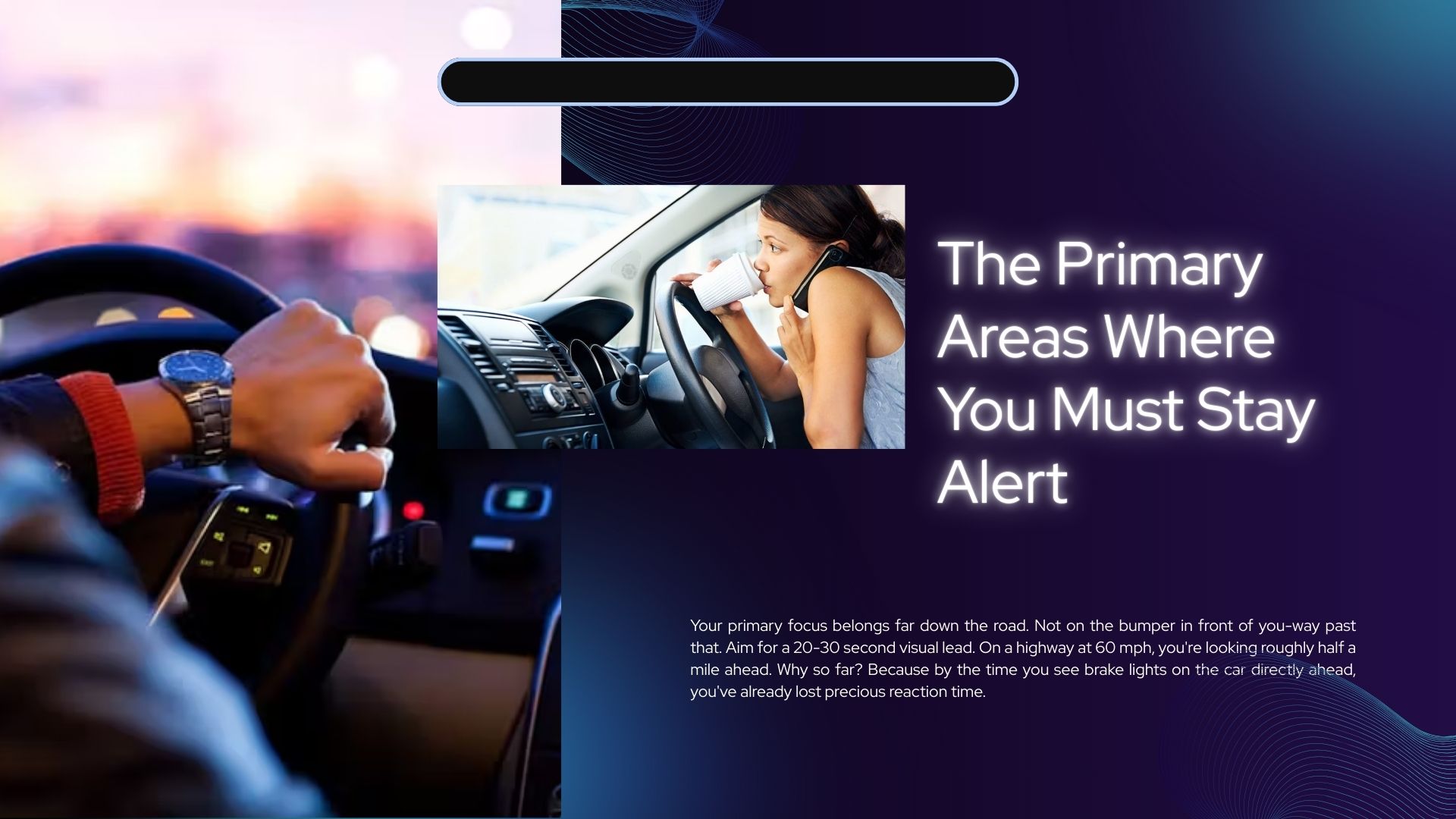
1. The Road Ahead: Your Primary Focus Zone
Your primary focus belongs far down the road. Not on the bumper in front of you-way past that. Aim for a 20-30 second visual lead. On a highway at 60 mph, you're looking roughly half a mile ahead. Why so far? Because by the time you see brake lights on the car directly ahead, you've already lost precious reaction time. But if you're watching three or four cars up, you'll catch those brake lights early and can ease off the gas smoothly instead of jamming the brakes.
What to watch for ahead:
- Traffic signs and signals indicating upcoming turns, speed changes, or road conditions
- Brake lights from vehicles two or three cars ahead, giving you advance warning of slowing traffic
- Changes in road conditions such as construction zones, potholes, debris, or slippery patches
- Pedestrians waiting at crosswalks or cyclists sharing the road
- Vehicles preparing to merge or change lanes ahead of you
By scanning far ahead, you create more reaction time. If you notice brake lights three cars ahead, you can begin slowing down smoothly before the car in front of you stops suddenly. This broader view helps you see changes or hazards long before you reach them.
2. Rearview and Side Mirrors: Monitoring Traffic Behind and Beside You
Looking ahead matters most, but your mirrors tell you what's happening behind and beside you. Check your rearview every 5-8 seconds. Not obsessively-just a quick glance that becomes automatic. Before you change lanes, turn, or merge, your side mirrors need checking too. For more on proper signaling when making these moves, see our guide on turn signals.
Mirror checking should include:
- Glancing at your rearview mirror every 5-8 seconds to track vehicles behind you
- Checking side mirrors before any lane change, turn, or merging maneuver
- Monitoring for aggressive drivers, emergency vehicles, or motorcycles approaching from behind
- Watching for vehicles in adjacent lanes that might drift into your space
In New York City traffic, where lanes are tight and drivers frequently change positions, consistent mirror checking becomes even more critical. Make it a habit to include your mirrors in your regular scanning pattern.
3. Blind Spots: The Hidden Danger Zones
Blind spots are exactly what they sound like-zones where vehicles disappear from your mirrors. Usually along your rear quarters, right where motorcycles and smaller cars like to hang out. We cover this extensively in our article on what are blind spots in driving, but here's the short version: mirrors aren't enough.
Managing blind spots:
- Adjust side mirrors to extend just past what you see peripherally
- Turn your head and look-actually physically look into the blind spot before changing lanes
- Give extra space to vehicles entering these zones
- Use blind spot detection if your car has it, but don't rely on it alone
That shoulder check takes one second. Skip it and you might sideswipe a motorcycle you never saw. Do it every time and it becomes as automatic as breathing.
4. Intersections: High-Risk Zones Requiring Maximum Attention
Intersections kill people. Multiple traffic streams crossing paths, pedestrians everywhere, drivers running lights or making unexpected moves. This is where most urban crashes happen. When you're turning right at an intersection, you need to check everywhere-not just where you think you should look.
What you're watching for:
- Pedestrians stepping into crosswalks without looking up from their phones
- Cyclists approaching from the side or waiting to cross
- That one driver who thinks red lights are suggestions
- Cars turning without signals (happens constantly in NYC)
- Traffic from all four directions-yes, even behind you
Green light doesn't mean safe. It means legal. Scan left-right-ahead before you go. Even with a green, make sure cross traffic actually stopped. In NYC, where aggressive driving is the norm, this habit saves lives.
5. Peripheral Vision: Detecting Motion and Side Threats
Central vision handles details straight ahead-reading signs, judging distances. Peripheral vision catches movement to the sides. It's not sharp, but it's fast. A kid darting toward the street, a car drifting into your lane-your peripheral vision spots these things before your central vision would.
This is why staring at one spot kills your awareness. Keep your eyes moving. Your peripheral vision works best when your central vision isn't locked on target.
Peripheral vision helps you notice:
- Cars approaching from side streets or driveways
- Pedestrians moving toward the road from sidewalks
- Children or animals that might dart into traffic
- Vehicles drifting toward your lane
One warning about peripheral vision: alcohol destroys it. After a few drinks, your vision narrows. Tunnel vision sets in. You're staring straight ahead while threats approach from the sides. This is one reason drunk drivers hit things they should have easily avoided. Don't drive impaired. Ever.
6. School Zones and Residential Areas: Heightened Alert Zones
Kids are unpredictable. They chase balls into streets. They dart between parked cars. They forget to look both ways. Parents get distracted during pickup. School zones and residential streets need your full attention, no exceptions.
In these areas, be especially alert for:
- School buses with flashing yellow or red lights-you must slow down and stop when required
- Children crossing streets between parked cars where they're hard to see
- Parents or caregivers walking with strollers
- Increased vehicle congestion during drop-off and pick-up times
- Reduced speed limits that may be enforced with cameras or police presence
Remember: if a school bus has its yellow lights flashing, you must slow down and prepare to stop. If the red lights are flashing and the stop-arm is extended, you must come to a complete stop and wait until the lights turn off and the bus begins moving. It's illegal to pass a stopped school bus with red lights flashing.
7. Highway Merging and Lane Changes: Critical Transition Points
Merging onto highways and changing lanes require checking everywhere at once-ahead, behind, beside, blind spots-all within seconds. We cover this in detail in our guide to driving on NYC highways safely, but here's the core issue: you're moving into someone else's space. They might not want to let you in.
What you're tracking:
- Speed in the target lane-match it before you try to merge
- Vehicles coming from behind in that lane
- Motorcycles hiding in your blind spot
- Other drivers who might also be planning to merge
- Gaps large enough that you're not forcing your way in
The sequence: mirror check, signal, shoulder check blind spot, verify it's clear, merge smoothly. Never force it. Never assume they'll make room. Wait for an actual opening.
8. Weather Conditions and Environmental Factors
Rain, snow, fog-these conditions change everything. Can't see as far? Need more distance to stop? Other drivers acting stupid? Welcome to weather driving. Your scanning needs to adjust.
Bad weather means watching for:
- Reduced visibility-look more often, look more carefully
- Longer stopping distances on slippery roads
- Drivers who haven't slowed down enough
- Standing water, ice, or snow on the pavement
- Pedestrians with umbrellas blocking their view
A 3-second following distance in dry conditions becomes 5-6 seconds in rain or snow. Your awareness needs to extend further because your ability to stop quickly just got worse.
How to Improve Your Visual Perception While Driving
Knowing where to look matters. Knowing how to look matters more. Most bad habits develop without you noticing. Here's how to fix them.
Keep Your Eyes Moving: Active Scanning Technique
Your eyes need to move. Constantly. Staring at one spot is how people crash into things they were looking right at. Professional drivers call this active scanning-your eyes are always checking different zones, building a complete picture.
Basic scanning pattern:
- Far ahead (12-15 seconds down the road)
- Rearview mirror (every 5-8 seconds)
- Side mirrors (regularly, before any maneuver)
- Peripheral zones (watch for movement)
- Intersections (all directions before entering)
This builds a mental map. You always know where vehicles are, what pedestrians are doing, how conditions are changing. That's the point.
Use the "What If?" Mental Exercise
Keep your brain engaged by asking "what if" questions. This isn't paranoia-it's preparation. When you've mentally rehearsed a scenario, your reaction is faster and smoother when it actually happens.
Examples:
- What if that driver stops suddenly?
- What if that pedestrian steps out?
- What if this light turns yellow right now?
- What if that car changes lanes without signaling?
Run these scenarios in your head. When something unexpected happens, you've already practiced the response.
Maintain Safe Following Distances
Following too closely limits your reaction time and narrows your field of vision. The general rule is to maintain at least a 3-second following distance in normal conditions, increasing to 5-6 seconds in adverse weather or heavy traffic.
To measure following distance, pick a fixed point ahead (like a sign or bridge). When the vehicle in front of you passes it, count "one thousand one, one thousand two, one thousand three." You should reach that point after completing the count. If you reach it sooner, you're following too closely.
Proper following distance gives you more time to observe what's happening ahead and react safely. It also improves your overall awareness because you can see beyond the vehicle immediately in front of you.
Learn from Larger Vehicles
When driving in traffic, larger vehicles like buses or trucks can provide valuable clues about road conditions ahead. These drivers often have a better view of what's happening further down the road from their elevated positions.
If you notice a truck or bus changing lanes or slowing down unexpectedly, it may indicate an issue ahead like an accident, construction, or roadblock. Paying attention to their movements can give you advance warning and time to adjust your driving accordingly.
Call Us Today 6AM-10PM
Or fill out the form 24/7
Our team is here to guide you with promotions, instructor availability, and the best training package for you.
Common Threats to Situational Awareness
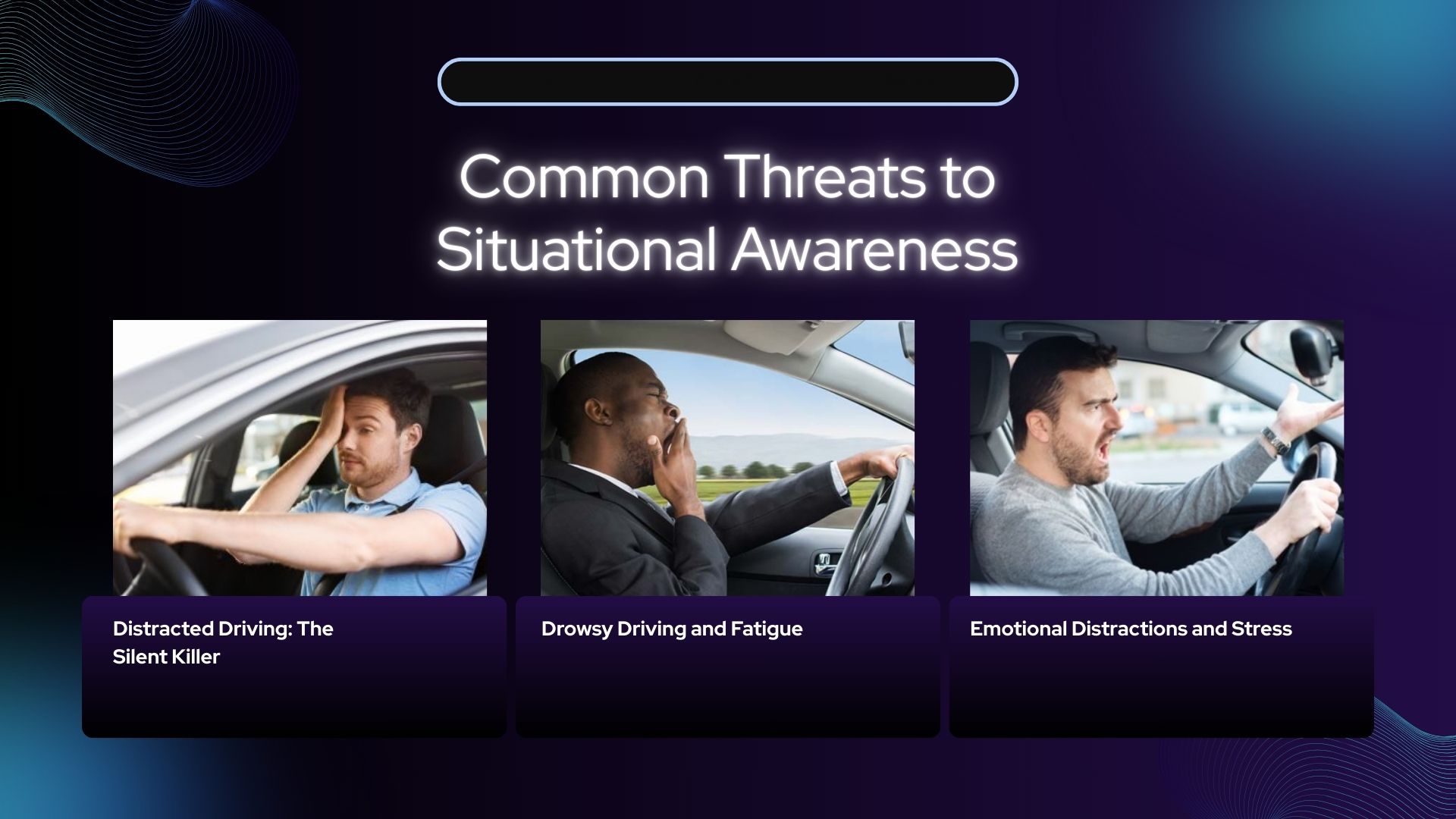
Understanding what interferes with your awareness is just as important as knowing where to focus your attention. Many factors can significantly reduce your ability to maintain situational awareness while driving.
Distracted Driving: The Silent Killer
Distracted driving kills more people than most drivers realize. Texting, eating, messing with the radio, arguing with passengers-anything that pulls your focus from the road drops your awareness to near zero. In New York State, holding a phone while driving is illegal. But even hands-free calls mess with your head. Your mind is elsewhere, which means you're not really driving.
Don't do this:
- Phone use-silence it and put it away
- Setting GPS while moving-do it before you start
- Eating or drinking behind the wheel
- Deep conversations with passengers
If something needs your attention, pull over. Every single crash caused by distraction was 100% preventable.
Drowsy Driving and Fatigue
Tired drivers are dangerous drivers. Your reaction time slows. Your awareness dulls. You might even experience microsleeps-brief moments where you're literally unconscious while driving 60 mph. If you're feeling drowsy, you're already past the point where you should have stopped.
Warning signs:
- Yawning repeatedly, can't keep eyes open
- Drifting between lanes or hitting rumble strips
- Missing exits or forgetting the last few miles
Feel any of these? Pull over somewhere safe and sleep. Coffee doesn't fix tired. Sleep does.
Emotional Distractions and Stress
Angry? Upset? Stressed about something that happened at work? That emotional noise in your head competes with road awareness. When you're thinking about an argument or worrying about a problem, you're not fully processing what's happening outside the windshield.
If you're emotionally worked up, take a few minutes before driving. Deep breaths. Calm music. Just wait until your head clears. Your emotional state affects every driving decision you make.
Overconfidence and Complacency
Experienced drivers sometimes become too comfortable and rely heavily on muscle memory, stopping active scanning of their environment. Familiar routes can create a false sense of security, leading to reduced vigilance.
Even on routes you drive daily, conditions change constantly. A child could be playing near the street, construction could block a lane, or another driver could run a red light. Treat every trip as if it requires your complete attention-because it does.
Special Considerations for New York City Driving
NYC driving has its own rules. Not legal rules-unwritten rules about survival. Dense traffic, aggressive drivers, pedestrians everywhere, cyclists weaving through lanes, delivery trucks double-parked on every block, construction that reroutes you constantly. If you're preparing for your New York driving test or nervous about your driving test, understanding these NYC-specific challenges is essential.
Heavy Pedestrian Traffic
NYC pedestrians don't wait for walk signals. They cross mid-block. They step into the street while staring at phones. They assume you'll stop because you're supposed to. Watch sidewalks and crosswalks constantly. Assume anyone near the curb might step out without looking.
Cyclists and Delivery Vehicles
Cyclists often share lanes with cars in NYC, and delivery vehicles on bikes and scooters weave through traffic. Always check blind spots before opening doors (to avoid dooring a cyclist) and give cyclists plenty of room when passing. Never underestimate their speed or assume they'll follow traffic laws.
Double-Parked Vehicles and Tight Spaces
Double-parked delivery trucks and tight lane configurations require constant adjustment. Be prepared to merge or navigate around obstacles, checking mirrors and blind spots more frequently than on wider suburban roads.
Complex Intersections and One-Way Streets
Many NYC intersections involve multiple lanes, complex turn patterns, and one-way streets that require careful attention to signage. Before entering any intersection, verify the traffic pattern, check for pedestrians from all directions, and watch for vehicles that might be making unexpected maneuvers.
How CoreWay Driving School Teaches Situational Awareness
At CoreWay driving school in New York City, we don't just teach vehicle operation-we focus extensively on developing situational awareness from the very first lesson. Our instructors help students build habits that will keep them safe throughout their driving lives.
Structured Scanning Drills
We teach students specific scanning patterns and practice them until they become automatic. Our instructors guide new drivers through the process of checking mirrors regularly, scanning ahead effectively, and performing shoulder checks before lane changes.
Real-World NYC Practice
Learning in the actual environment where you'll drive is invaluable. We expose students to various NYC scenarios-busy Manhattan streets, highway merging on the BQE and FDR, residential areas in Queens and Brooklyn, and complex intersections throughout the city. This diverse practice builds genuine confidence and awareness.
Defensive Driving Principles
Our curriculum emphasizes defensive driving techniques that center on awareness. We teach students to expect the unexpected, anticipate other drivers' mistakes, and always have an escape route. These principles transform students from passive vehicle operators into active, aware drivers.
Hazard Recognition Training
We train students to recognize developing hazards before they become emergencies. This includes reading body language of pedestrians, noticing early warning signs that a vehicle might change lanes, and identifying road conditions that require speed adjustment.
Awareness Equals Safety
Look at the road ahead. Check your mirrors. Watch for blind spots. Scan intersections before entering. Use your peripheral vision. Adjust for weather. That's where your attention belongs. Miss any of these and you're gambling with your safety and everyone else's.
Most people treat driving like it's routine. It's not. Conditions change constantly. Risks appear without warning. Situational awareness isn't optional-it's the difference between arriving safely and not arriving at all.
Build the habits now. Keep your eyes moving. Eliminate distractions. Maintain following distance. Practice defensive techniques. These aren't tips for new drivers-they're practices every driver needs, regardless of experience.
At CoreWay in New York City, we focus on building these awareness habits from day one. Our training goes beyond basic vehicle operation. We teach you how to read traffic, anticipate problems, and make decisions before situations become emergencies. Whether you're learning skills like how to parallel park or preparing for your road test, we develop the complete skillset you need for NYC roads.
Contact CoreWay today. Learn to drive with real awareness. Not just to pass a test, but to stay safe in actual NYC traffic.
Call Us Today 6AM-10PM
Or fill out the form 24/7
Our team is here to guide you with promotions, instructor availability, and the best training package for you.
Frequently Asked Questions
-
What is situational awareness while driving?
Situational awareness means knowing what’s happening around your car right now and what’s about to happen next. It’s not just seeing the taxi in front of you, but noticing the pedestrian on your right approaching the curb while looking at their phone, catching brake lights two cars ahead before everyone else reacts, and processing the complete traffic picture instead of tunnel vision on the bumper ahead.
-
How far ahead should I look when driving?
You should look at least 20–30 seconds ahead while driving, which means looking far past the car directly in front of you. On highways at around 60 mph, this can be close to half a mile. Looking this far ahead gives you time to identify problems early and react smoothly instead of making sudden emergency maneuvers.
-
How often should I check my mirrors while driving?
Check your rearview mirror every 5–8 seconds as part of a continuous scanning routine. Side mirrors should be checked before every lane change, turn, or merge, and periodically during normal driving. Regular mirror checks keep you aware of vehicles behind and beside you, emergency vehicles approaching, and overall traffic flow.
-
What are blind spots and how do I check them?
Blind spots are areas around your car that mirrors cannot fully show, usually along the rear corners. Cars and motorcycles often hide there. To check blind spots correctly, use your mirrors first and then physically turn your head to look over your shoulder. This must be done every time before changing lanes or merging. Mirrors alone are not sufficient.
-
Why is situational awareness more important in NYC than other places?
Driving in NYC is extremely compressed and unpredictable. There is heavy pedestrian traffic, cyclists everywhere, delivery trucks double-parked, narrow lanes with no room for error, aggressive drivers, and complex intersections with multiple traffic streams. Things happen from every direction with little warning, and missing one detail for even a second can lead to an incident.
-
What is the “what if” driving technique?
The “what if” technique is a mental exercise used while driving. You constantly ask yourself questions like “what if that driver stops suddenly?” or “what if that pedestrian steps into the road?” By mentally rehearsing these scenarios, your real-world reactions become faster and smoother when situations actually occur.
-
How does fatigue affect driving awareness?
Fatigue significantly reduces alertness and slows reaction time. Your brain struggles to process information correctly, and microsleeps can occur, where you fall asleep for a few seconds without realizing it. Tired drivers drift between lanes, miss signs, and forget what just happened. If you feel drowsy, pull over and rest—coffee does not fix true fatigue.
-
What is the proper following distance and why does it matter?
The minimum following distance is 3 seconds in normal conditions and 5–6 seconds in bad weather. To measure it, pick a fixed point on the road and start counting when the car ahead passes it. You should reach that point after finishing the count. Proper following distance gives you reaction time and improves visibility beyond the vehicle in front of you.
-
Can experienced drivers become too complacent?
Yes, experienced drivers often become overly comfortable and rely on muscle memory instead of active scanning. Familiar routes feel safe, leading drivers to zone out, but conditions change constantly. Construction, pedestrians, and reckless drivers appear without warning. Experience does not reduce risk—every trip requires full attention.
-
How can I improve my situational awareness while driving?
You can improve situational awareness by keeping your eyes moving with active scanning, practicing the “what if” technique, maintaining proper following distance, eliminating distractions such as phone use, getting adequate rest, checking mirrors every 5–8 seconds, and always performing shoulder checks for blind spots. Defensive driving courses also help. At CoreWay driving school in NYC, we provide focused training on building these awareness skills in real-world city driving.